Cold-Weather RV Camping: Furnace, Heat Pump and Freeze Protection
In this guide
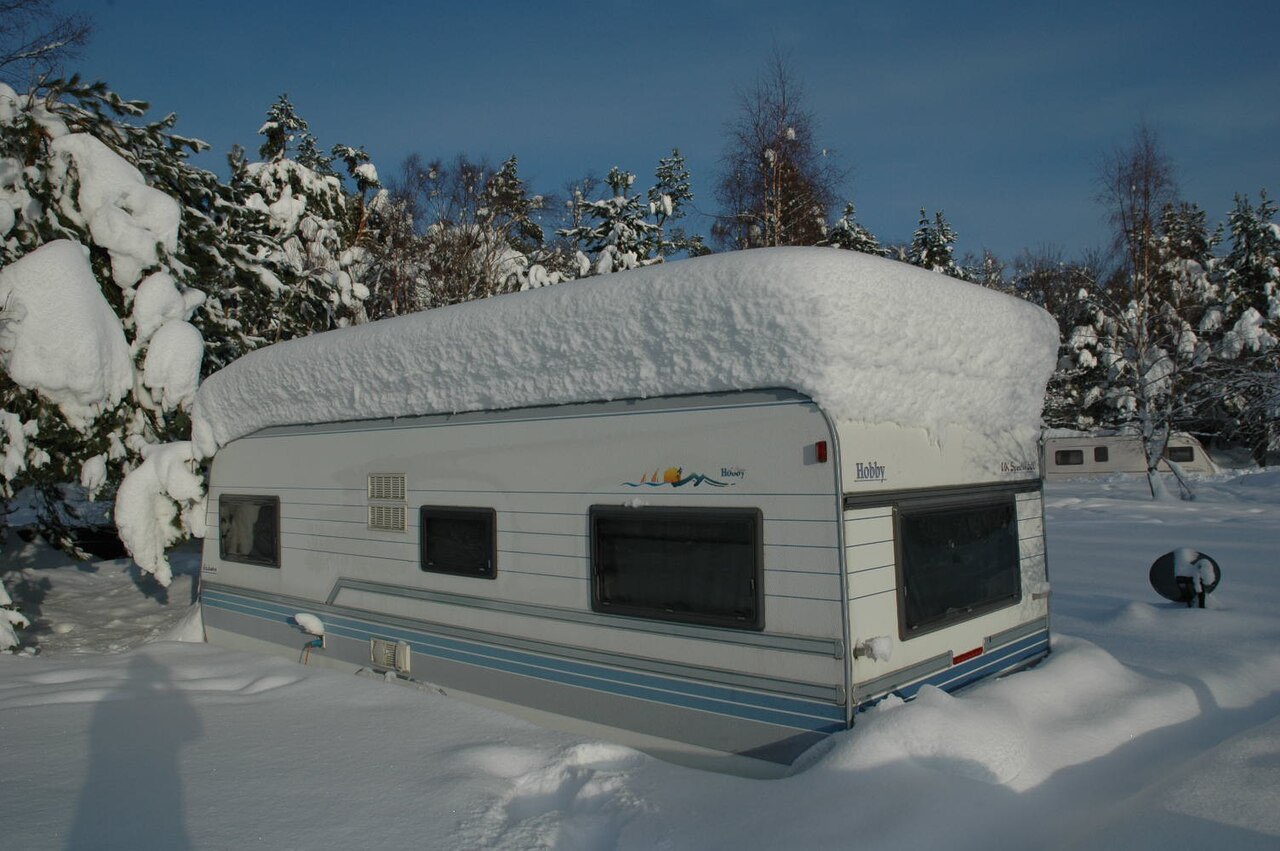
You can camp in an RV below freezing, but the rig has to be set up for it: a working propane furnace as the main heat, a plan for keeping water from freezing (heated underbelly and tank heaters, or no water in the lines at all), enough propane and battery for the furnace, and a way to deal with condensation. For a night or two in the 20s, most RVs manage with the furnace running and the fresh water in the tank rather than the hose. For a week of single digits, you need an insulated rig with heated tanks, skirting, and a refill plan for propane.
This guide covers what your heat sources can actually do (furnace, heat pump, electric), how much propane and battery the furnace burns, what freezes first and how to protect it, skirting, condensation, and what “four-season” claims mean.
Disclosure: As an Amazon Associate I earn from qualifying purchases. Some brands linked below pay a bonus commission through Amazon Creator Connections. See /disclosure/.
Your heat sources, and their limits
| Heat source | Typical size | Fuel / power | Works well down to | Notes |
|---|---|---|---|---|
| Ducted propane furnace | 20,000–40,000 BTU/h input (Suburban NT series) | Propane plus a 12V blower (2.8–9.5 A) | Any temperature | The only RV heat that also warms the underbelly ducts in most trailers |
| Heat pump (rooftop A/C with reverse cycle) | Varies | 120V shore power | Mild cold; output drops as it gets colder | Many hand off to the furnace near 30°F |
| Electric space heater | 1,500 W | 120V, 12.5 A | Any, but heats only the room | Cheap at metered-free sites; does not heat tanks or lines |
| Electric fireplace / heat strip in A/C | 1,000–1,500 W typical | 120V | Any, limited output | Supplemental only |
The furnace
Suburban’s furnace service manual lists its 12-volt NT models from 12,000 to 40,000 BTU per hour of input, with blower draws from 2.8 amps on the small units to 5.5 amps on the popular NT-30SP and 9.5 amps on the NT-40. Input is not output: the sample rating plate in the same manual shows an SF-35F rated 35,000 BTU/h in and 27,300 out, so roughly a fifth of the heat goes out the exhaust.
The furnace matters beyond comfort. In most travel trailers and fifth wheels, the furnace ducting runs through the enclosed underbelly, and that warm air is what keeps the tanks and lines above freezing. Turning the furnace down at night to save propane and running a space heater instead can leave the underbelly unheated.
Propane math. The EIA puts propane at 91,452 Btu per gallon.
| Furnace (Suburban input rating) | Propane per burner-hour | Per day at 50% run time | Blower Ah per day at 50% |
|---|---|---|---|
| NT-20S, 19,000 BTU/h, 2.8 A | 0.21 gal | 2.5 gal | 34 Ah |
| NT-30SP, 30,000 BTU/h, 5.5 A | 0.33 gal | 3.9 gal | 66 Ah |
| NT-40, 40,000 BTU/h, 9.5 A | 0.44 gal | 5.2 gal | 114 Ah |
The 50 percent run time is an illustration, not a forecast: a well-insulated fifth wheel on a calm 30°F night may cycle far less, and a thin-walled trailer in a 10°F wind may run most of the hour. A 30 lb cylinder holds roughly 7 gallons and a 20 lb roughly 4.7, so two 30 lb cylinders can be gone in three or four cold days. Find a propane fill nearby before you go, and see the propane basics guide for tank sizes.
Battery math. The blower draw is the part dry campers forget. At 66 amp-hours a day for an NT-30SP, a single 100 Ah lead-acid battery (about 50 Ah usable) will not last a night of cold camping. Lithium batteries hold up better, but most lithium iron phosphate batteries must not be charged below about freezing unless they have built-in heaters; check your battery’s spec sheet. The lithium vs AGM guide and the generator sizing guide cover the off-grid side; plan on a generator or shore power for multi-day cold trips.
The heat pump
A heat pump moves heat from outside air into the RV, and there is less of it to move as the temperature falls. RV heat pumps are commonly wired to hand off to the furnace near freezing. Dometic’s literature for its Penguin II heat pump describes the thermostat switching to the LP furnace at about 30°F, while owners on RV forums report units that kept running at 22°F without switching. Treat the heat pump as a shoulder-season heater for the 40s and 50s and confirm on your first cold night that the furnace really takes over.
Electric heat at hookups
A 1,500-watt space heater draws 12.5 amps at 120 volts. On a 30-amp site that leaves room for little else; two heaters plus the water heater element will trip the pedestal. Run your loads through the RV electrical load calculator, and read the 30 vs 50 amp guide if you are unsure what your service supports.
What freezes first, and how to protect it
In rough order of vulnerability:
- The fresh water hose and campground spigot. Exposed to wind on all sides. Heated drinking-water hoses are sold with ratings such as -20°F or -40°F depending on model; read the rating on the one you buy and wrap the spigot too. The alternative many winter campers use: fill the fresh tank, disconnect and drain the hose, run on the pump, refill every few days.
- The sewer hose and gate valves. Keep the gray and black valves closed and dump on a warm afternoon; a frozen sewer hose with a slug of gray water in it is a long day. Some campers carry the hose inside between dumps. The black tank care guide covers dumping routines.
- Low-point drains, the city water inlet and outside shower. Lines on the exterior wall and drains hanging below the belly.
- Holding tanks. Tank heater pads (12-volt, thermostatically controlled) stick to the tank bottoms. Retail listings for common pads show them switching on around 44°F and off in the mid-60s, at roughly 65 watts each, about 5 amps per pad on 12 volts. That is a real battery load off-grid.
- The water heater. A tank heater stays warm while it runs. A tankless unit like the Girard GSWH-2 has its own freeze thermostat that fires the burner below 38°F, but its manual notes it protects only the heater and needs propane and 12-volt power on. See RV water heater types.
- The absorption refrigerator. Norcold’s manual says absorption fridges are not designed for freezing temperatures; without the low-temperature option they may stop cooling after extended exposure at 32°F or below, and Norcold’s warranty does not cover it. The refrigerator guide explains the difference with 12-volt units.
Inside tricks that help: open the cabinet doors under the sinks and in the bathroom so cabin heat reaches the plumbing against the outside walls; keep a small trickle of heat in the basement bays of a motorhome; and keep the thermostat steady rather than letting the coach cool deeply overnight.
If you will not use water at all, the simplest plan is to travel winterized and carry jugs, as described in the winterizing guide. Nothing to freeze, nothing to thaw.
Gear worth a look (affiliate links)
If you will keep the hose connected, the Kohree 15 ft heated RV drinking water hose is, per the listing, a 5/8-inch NSF 372 drinking-water hose with freeze protection rated to -40°F and an energy-saving thermostat. It heats only when plugged into power, so it is for hookup sites, not boondocking, and it protects the hose only: the spigot, the city water inlet and the rig’s own lines still need the steps above. $59.99Price as of November 16, 2026, 10:00 AM ET. Prices and availability are accurate as of the date/time indicated and are subject to change. Any price and availability information displayed on Amazon.com at the time of purchase will apply to the purchase of this product.
Skirting
Skirting closes the gap between the bottom of the RV and the ground so wind cannot strip heat from the floor and underbelly. It is the single biggest upgrade for anyone staying put for weeks.
| Skirting type | Cost (relative) | Setup | Notes |
|---|---|---|---|
| Foam board (rigid insulation panels) | Low | Cut to fit, tape seams | Effective; bulky to carry, best for a season in one place |
| Vinyl or fabric snap-on skirting | High | Snaps installed on the rig | Packs flat, reusable, custom-fit |
| Inflatable skirting | High | Inflate, place around rig | Fast to set up and take down |
| Straw bales, plywood, tarps | Low to moderate | Varies | Allowed in some parks, banned in others; check rules |
Leave an access point for the furnace exhaust, water heater exhaust and fresh-air intakes: skirting must never cover the furnace or water heater exhaust vents, and the space should not trap propane. Many owners add a small, thermostatically controlled heat source inside the skirt; follow the device’s clearance rules.
Condensation
Two people breathing, cooking and showering in a closed RV put a surprising amount of water into the air, and cold walls and single-pane windows are where it lands. Left alone it soaks mattresses against outside walls and grows mold in closets.
- Crack a roof vent slightly (a covered vent can stay open in snow) and run the bathroom and range fans when showering or cooking.
- A small electric dehumidifier at hookups, or moisture-absorbing tubs off-grid.
- Window insulation film or reflective panels on the worst windows.
- Keep bedding off the outside walls; check under the mattress weekly.
Propane combustion from the ducted furnace vents outside and does not add moisture to the cabin. Unvented catalytic or “buddy” heaters do add moisture, along with combustion gases; if you use one, follow its ventilation and clearance instructions exactly and keep the CO alarm working.
Safety
- Never heat with the stove or oven. CDC guidance is to never use a gas range or oven to heat a home and never use camp stoves, lanterns or grills inside a camper.
- Test the CO alarm and propane detector before each winter trip. Both run off the house battery; a dead battery means no alarm.
- Keep exhaust vents clear of snow, including the furnace, water heater and generator exhausts. Snow drifting against a generator exhaust can push carbon monoxide under the coach.
- Clear heavy snow from the roof and slide-out toppers. Wet snow is heavy, and meltwater pools against sealant at seams and vents; the roof inspection guide covers what to check after a winter.
- Batteries: a discharged lead-acid battery freezes much sooner than a charged one. Trojan’s storage guide puts a fully charged flooded battery’s freezing point near -92°F and a 40 percent charged one near +5°F.
What “four-season” really means
We found no industry-wide test standard behind “four-season,” “all-season” or “arctic package.” Each manufacturer defines its own. Jayco, for example, describes its Climate Shield package as extra wall and cap insulation plus heat and freeze-protection materials around plumbing and wiring, tested with Dometic; third-party reports describe that test as eight hours at 0°F in a climate chamber, and dealer disclaimers note that freeze damage is not covered under warranty. A chamber has no wind, no ground contact and no open door.
Questions to ask the dealer or manufacturer:
| Ask | Why |
|---|---|
| What temperature and for how long was it tested? | “Rated to 0°F” might mean eight hours in still air |
| Is the underbelly enclosed and heated by furnace ducting? | Determines whether tanks and lines stay warm |
| Are tank heaters standard, and on which tanks? | Pads are often optional or fresh-tank only |
| Window type and wall insulation (R-values)? | Single-pane windows dominate heat loss |
| Does the warranty exclude freeze damage? | Many do |
If your RV has none of these features, you can still camp in the cold for short stints with the water system winterized, the furnace on, a full propane supply and a charged battery. For weeks below freezing, an insulated rig, skirting and a heated water plan are what make it livable. If you are choosing where to go, the RV camping options guide covers which parks stay open with water in winter.
Specifications above were read from Suburban’s furnace service manual, Norcold’s and Girard’s owner’s manuals, the EIA’s propane conversion, Jayco’s Climate Shield page and CDC’s carbon monoxide guidance on October 28, 2026; heat pump cutoff and accessory ratings are from secondary sources and hedged. Your appliance manuals override anything here.
Frequently asked questions
How much propane does an RV furnace use in cold weather?
A common 30,000 BTU/h ducted furnace, such as Suburban's NT-30SP, burns about a third of a gallon of propane per hour while the burner is on (30,000 divided by the EIA's 91,452 Btu per gallon). If it ran half of every hour on a cold night, that is roughly 4 gallons a day, or most of a 30 lb cylinder. Insulation, wind, skirting and thermostat setting move the number a lot, so watch your gauge for the first two nights and plan refills from that.
Will my RV heat pump work in freezing weather?
Not well. RV heat pumps lose output as it gets colder, and many are set up to hand off to the propane furnace near freezing. Dometic's literature for its Penguin II heat pump describes the thermostat switching to the LP furnace at about 30°F, and owners report the switch does not always happen, so check that your furnace actually takes over. Below about 40°F, plan on the furnace as your main heat.
Can I keep the fresh water hose connected below freezing?
Only with a heated hose plugged in, and even then the faucet and its pipe can freeze. Heated hoses are sold with ratings such as -20°F and -40°F depending on the model. Many winter campers instead fill the fresh tank, disconnect and drain the hose, and refill every few days, which leaves nothing outside to freeze.
What does 'four-season' or 'all-season' mean on an RV?
Whatever that manufacturer says it means; we found no industry-wide test standard behind the term. Typical features are thicker insulation, an enclosed and heated underbelly, heated tanks and dual-pane windows. Ask for the specific test temperature and duration, read the warranty for freeze-damage exclusions, and remember that a test chamber has no wind.
Is it safe to use the stove or a space heater for heat in an RV?
Do not use the cooktop or oven for heat. CDC guidance says never to heat with a gas range or oven and never to use camp stoves, lanterns or grills inside a camper. An electric space heater at hookups is fine if the circuit can carry about 12.5 amps for a 1,500-watt unit. Keep a working carbon monoxide alarm and propane detector, and test both before every winter trip.
Keep planning
- Black Friday RV Campground Membership and Gear Deals 2026
What to look for in RV campground memberships and outdoor gear Black Friday deals in 2026, including Thousand Trails, KOA and Harvest Hosts.
Updated Nov 2026 - Boondocking for Beginners: Rules, Water and Power
Boondocking for beginners: BLM and Forest Service dispersed camping rules, 14-day limits, Motor Vehicle Use Maps, Leave No Trace, water and power budgets.
Updated Nov 2026 - RV Campground Apps: The Best for Finding and Booking Sites (2026)
The best RV campground apps compared with 2026 official prices: Recreation.gov, Campendium, The Dyrt, iOverlander, RV LIFE, Harvest Hosts and Hipcamp.
Updated Nov 2026