RV Generator Sizing and Campground Quiet Hours
In this guide
- Step 1: what you actually need to power
- Step 2: match the generator
- Inverter vs conventional
- Campground generator hours: they vary loop by loop
- Carbon monoxide: the part that can kill you
- Fuel: gasoline, propane or diesel
- Operating habits that make it last
- Alternatives to running a generator
- Mistakes to avoid
To run a typical 13,500 or 15,000 BTU roof air conditioner from a generator, plan on about 3,000 watts of generator capacity, or a 2,000 to 2,200 watt inverter generator plus a soft-start device and strict load management. Without air conditioning, a 2,000-watt class inverter generator covers lights, the converter, the refrigerator and a microwave used on its own. In campgrounds, the size of generator you can use is limited less by watts than by noise rules and posted hours: federal land caps equipment noise, many loops ban generators outright, and quiet hours usually start at 10 p.m.
Figures below come from Coleman’s Mach 15 air conditioner spec sheet, Honda’s EU2200i owner’s manual, the Code of Federal Regulations, Recreation.gov campground pages and the U.S. Consumer Product Safety Commission, read in October 2026. Your own air conditioner’s nameplate and generator manual are what count; check them.
Disclosure: As an Amazon Associate I earn from qualifying purchases. Some brands linked below pay a bonus commission through Amazon Creator Connections. See /disclosure/.
Step 1: what you actually need to power
Add up what will run at the same time, not everything you own. Our RV electrical load calculator does the arithmetic; the numbers that dominate it are:
| Load | Running watts | Note |
|---|---|---|
| Coleman Mach 15 (15,000 BTU) air conditioner | 1,650 W in standard test, 1,900 W at 115°F and 103.5 V | 63 A locked rotor at start-up (Coleman spec sheet) |
| 13,500 BTU air conditioner | Typically 1,300 to 1,700 W | Check the nameplate |
| Microwave | Typically 1,000 to 1,500 W | Rated cooking watts are lower than draw |
| Electric water heater element | About 1,400 W | Switch to propane on generator power |
| Converter charging batteries | Typically 300 to 800 W | Higher when batteries are low |
| Residential refrigerator | Typically 150 to 400 W | Absorption fridges can run on propane instead |
The Coleman Mach 15 spec sheet is worth reading for one line: the compressor’s locked rotor current is 63 amps. For the first fraction of a second as the compressor starts, it draws several times its running current, roughly 7,000 volt-amps at 115 volts. That start-up surge, not the running watts, is what trips small generators. Coleman itself notes that it does not size generators and that you must add up the whole RV’s consumption.
Step 2: match the generator
| Generator class | Continuous output | What it runs | Who it suits |
|---|---|---|---|
| 2,000 to 2,200 W inverter | About 1,600 to 1,800 W | Everything but air conditioning; one A/C only with a soft start and nothing else | Weekend campers, trailers with one A/C used rarely |
| Two 2,000 to 2,200 W inverters in parallel | About 3,200 to 3,600 W | One A/C plus normal loads on a 30 amp rig | Flexibility: carry one or both |
| 3,000 to 3,500 W inverter | About 2,800 to 3,000 W | One A/C plus normal loads | 30 amp rigs that need A/C off-grid |
| Built-in 4,000 W (common on Class C) | About 4,000 W | One A/C, microwave, charger | Motorhome owners |
| 5,500 W and up, built-in | 5,000+ W | Two A/Cs on a 50 amp coach | Class A owners |
Honda’s EU2200i manual illustrates the gap between the two numbers on the box: its overload alarm trips above 2.2 kVA, while its continuous rating is 1.8 kVA. Two EU2200i units in parallel are rated together at up to 4.4 kVA. Plan around the continuous figure. Winnebago’s Class C motorhomes ship with a 4,000-watt onboard generator, which comfortably runs one air conditioner and is why most Class Cs are wired for 30 amp service.
A soft-start device installed in the air conditioner stretches out the compressor’s start-up so its surge is much smaller. It is what lets 2,000 to 2,200 watt inverters start a roof air conditioner at all. Results depend on the unit, the altitude and the temperature, so test it at home before relying on it in the desert.
The arithmetic of 30 and 50 amp service, and why a generator never gives you more than its own rating, is in our 30 amp vs 50 amp guide.
Inverter vs conventional
Inverter generators produce power electronically, so the engine can idle down when the load is light. That makes them quieter at low load, lighter, and cleaner-power for electronics. Conventional (open-frame) generators run at a fixed speed, so they are loud all the time, but they give more watts per dollar.
For campgrounds the choice is made for you by noise rules:
- In national park areas, 36 CFR 2.12 prohibits running motorized equipment, naming “an electric generating plant” specifically, in a way that exceeds 60 decibels on the A-weighted scale measured at 50 feet, or that is unreasonable for the time and place even below that.
- On national forest land, 36 CFR 261.10 prohibits operating a motor or engine in or near a campsite or developed recreation site in a way that unreasonably disturbs anyone.
Retailer listings for small inverter generators commonly quote high-40s to high-50s decibels measured at 7 meters (about 23 feet), depending on load. A conventional contractor generator is far louder. Even a quiet inverter running an air conditioner at full load is noticeable to the next site.
Campground generator hours: they vary loop by loop
There is no single national schedule. Each park, forest or state system posts its own, often per campground and sometimes per loop. Two campgrounds in the same park, as listed on Recreation.gov in October 2026:
| Campground (Grand Teton NP) | Where generators are allowed | Hours |
|---|---|---|
| Gros Ventre | Loops A, B, C and the East Corridor only | 8 a.m. to 10 p.m.; quiet hours 10 p.m. to 8 a.m. |
| Lizard Creek | First loop only, sites 48 to 63 | 8 a.m. to 8 p.m.; never left running unattended |
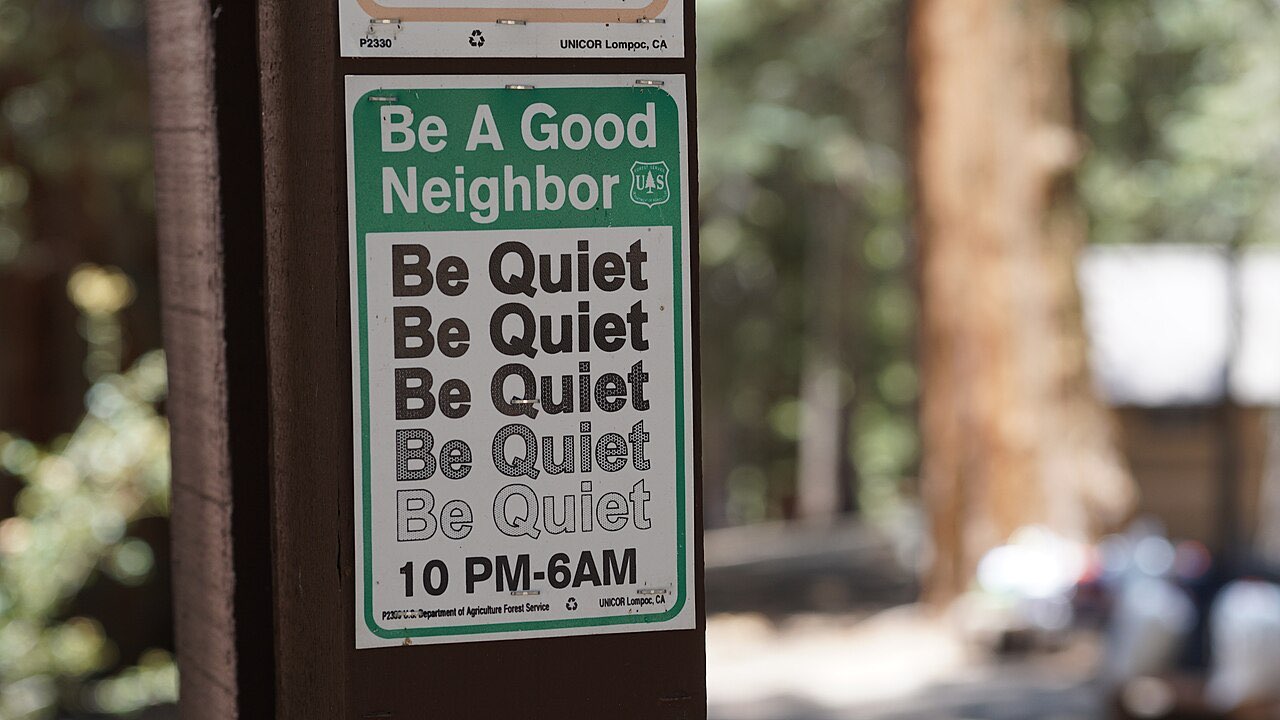
Biscayne National Park’s campground rules set quiet hours from 10 p.m. to 6 a.m. with no generators. The San Bernardino National Forest sign above posts 10 p.m. to 6 a.m. Private parks with hookups often restrict or ban generators, since every site has shore power; ask when you book.
Read the campground’s Recreation.gov page before you book: generator loops are often a separate set of sites, and a “no generator” loop is where tent campers go for quiet. Our sister site keeps a park-by-park summary of national park generator rules and the Grand Teton RV campgrounds in detail. On dispersed public land there are usually no posted hours, but the “unreasonable noise” rules above still apply, and the courtesy rules in our boondocking guide are how you avoid becoming the reason a site closes.
Carbon monoxide: the part that can kill you
Generator exhaust contains carbon monoxide, which is colorless and odorless. Honda’s EU2200i manual says CO can kill in minutes and to run the generator only outside, far from windows, doors and vents, never in an enclosed or partly enclosed space. The CPSC’s May 2026 safety release tells people to run portable generators at least 20 feet from homes and buildings with the exhaust directed away from openings, and to look for models with an automatic CO shut-off; it notes that generators certified to PGMA G300-2023 and UL 2201-2023 include CO safety technology.
At a campsite:
- Place the generator so the exhaust points away from your RV and your neighbor’s, downwind if possible. Never put it under the awning, in a slide-out’s shadow against the wall, or inside a truck bed with a camper shell.
- Keep windows on that side closed while it runs. Jayco’s manual says to keep windows closed when the generator is running to avoid drawing exhaust in.
- Make sure the RV’s CO alarm works before you start. It runs off the house battery; do not disconnect it.
- Built-in generators exhaust under the RV. Do not run one when parked against a snowbank, a wall or tall grass that can trap exhaust, and check the exhaust pipe for damage.
- Never sleep with a generator running unless the RV has a working CO alarm, per Jayco’s manual on automatic generator start systems.
Fuel: gasoline, propane or diesel
- Gasoline is the default for portables and Class C/Class A gas coaches. Stored gasoline degrades: Jayco’s manual says fuel can begin to varnish a generator’s carburetor in as little as 30 days. Its fix is to run a gasoline generator at at least 50 percent load for two hours every four weeks (about 2,000 watts, or one air conditioner, on a 4,000-watt set).
- Propane stores indefinitely. Dual-fuel portables run on either. Most are rated for fewer watts on propane than on gasoline, so read both numbers. A generator draws from the same propane supply as your furnace and water heater; see RV propane basics for how fast a 20-pound cylinder goes.
- Diesel generators come on diesel pushers and draw from the main fuel tank.
Operating habits that make it last
From Jayco’s manual for its onboard generator, which apply to most:
- Turn off air conditioners and big loads before starting.
- Let the engine warm up for about two minutes before connecting loads.
- Before shutting down, switch off big loads and let it run 3 to 5 minutes to cool.
- Do not crank a built-in generator for more than 20 seconds at a time.
Plug a surge protector or EMS between generator and RV just as at a pedestal. Some portable generators have a floating neutral that makes an EMS report an open ground; the manufacturer-approved fix is a neutral-ground bonding plug, covered in our surge protector guide.
Alternatives to running a generator
A battery bank with an inverter and solar can cover everything except air conditioning for days, silently and with no fuel. Our RV solar basics guide and RV batteries: lithium vs AGM vs flooded explain how big a system needs to be. Many boondockers carry a small inverter generator only for cloudy stretches.
Gear worth a look (affiliate links)
Two gas inverter generators near the 2,000-watt class in the table above: the Poulan Pro 2300W inverter generator, which per the listing has a CO sensor and ECO mode and is parallel ready, and the NOVUS 2300W inverter generator, which per the listing has a 30 amp RV outlet, a CO sensor and parallel capability. The 2,300 watts is the headline figure; check each listing for the continuous (running) rating before you plan an air conditioner around it, and check its decibel figure against the 60 dBA at 50 feet rule above. $379.99Price as of November 16, 2026, 10:00 AM ET. Prices and availability are accurate as of the date/time indicated and are subject to change. Any price and availability information displayed on Amazon.com at the time of purchase will apply to the purchase of this product.
 $319.99Price as of November 16, 2026, 10:00 AM ET. Prices and availability are accurate as of the date/time indicated and are subject to change. Any price and availability information displayed on Amazon.com at the time of purchase will apply to the purchase of this product.
If you only need quiet power for lights, phones and laptops, the VTOMAN Jump 600X portable power station is, per the listing, a 600-watt unit (1,200-watt surge) with 9 ports. It burns no fuel and makes no exhaust, but it will not run a roof air conditioner.
Mistakes to avoid
- Sizing to running watts only. The compressor start-up surge trips undersized generators.
- Booking a generator-free loop and planning on air conditioning.
- Running it at 9:58 p.m. Quiet hours start when the sign says.
- Pointing exhaust at a neighbor’s open window, or your own.
- Leaving gasoline in a generator for months without running or stabilizing it.
- Bypassing an EMS that reports an open ground on generator power. Use the bonding plug instead.
Rules, hours and specifications above are as published in October 2026. Campground generator rules change by season and loop; check the campground’s page and the posted sign every time.
Frequently asked questions
What size generator do I need to run an RV air conditioner?
Plan on about 3,000 watts for one 13,500 to 15,000 BTU roof air conditioner plus the converter and a few small loads. Coleman's spec sheet for its Mach 15 rates it at 1,650 running watts in standard test conditions and 1,900 watts on a 115°F day at low voltage, but the compressor draws 63 amps for a moment at start-up. A 2,000 to 2,200 watt inverter generator can run that air conditioner only with a soft-start device and little else running.
Inverter or conventional generator for an RV?
Inverter generators are quieter, lighter and throttle down at light loads, which is why most campgrounds and RVers favor them. Conventional open-frame generators give more watts per dollar but are louder and often too loud for national park campgrounds, where federal rules cap equipment at 60 decibels measured 50 feet away. For campground use, an inverter generator is the practical choice.
What are generator hours in national park campgrounds?
They vary by park and by campground, and many loops ban generators entirely. Examples on Recreation.gov for Grand Teton in October 2026: Gros Ventre allows generators only in loops A, B, C and the East Corridor from 8 a.m. to 10 p.m., while Lizard Creek allows them only in its first loop from 8 a.m. to 8 p.m. and never unattended. Check the campground page before you book and the posted sign when you arrive.
How far should a generator be from an RV?
Far enough that exhaust cannot drift into your RV or a neighbor's. The CPSC tells people to run portable generators at least 20 feet from homes and buildings with the exhaust pointed away from windows, doors and vents, and never inside an enclosed space. At a campsite that means away from open windows and the awning, exhaust pointed downwind and away from other campers, and a working CO alarm inside.
Can a 30 amp RV run on a 2,000 watt generator?
It can plug in, but it cannot use the full 30 amps. A 30 amp service is 3,600 watts; a 2,000 watt class generator delivers about half of that continuously. You can run lights, the converter, a refrigerator, a microwave on its own, and possibly one air conditioner with a soft start, but not the air conditioner and microwave together.
Are propane generators better for RVs?
Propane stores indefinitely and does not varnish a carburetor the way stored gasoline can, and dual-fuel portables let you choose. The trade-offs are that generators are typically rated for fewer watts on propane than on gasoline, so check both figures on the label, and that a running generator uses propane from the same supply as your furnace and water heater.
Keep planning
- How to Use an RV Dump Station Step by Step
How to use an RV dump station: black-then-gray order, hose setup, rinsing, chemicals, where to find free stations, typical fees and what never goes down the drain.
Updated Nov 2026 - RV Sewer Hose Setup: Length, Supports and Fittings
RV sewer hose setup explained: what length to carry, the clear elbow and 4-in-1 adapter, hose supports for a steady downhill run, valve habits and clean storage.
Updated Nov 2026 - RV Gear and Upgrades: Measure Before You Order
Fit guide for RV steps, bunk ladders, windows, shades, hose tubes, tote carriers and vents. Sizes come from the Amazon listings, including where a listing disagrees.
Updated Nov 2026