RV Batteries: Lithium vs AGM vs Flooded
In this guide
If you mostly camp with hookups, a flooded or AGM lead-acid battery is enough and cheaper up front. If you camp off-grid even a few nights a month, lithium iron phosphate (LiFePO4) is usually the better buy: a 100 amp-hour lithium battery gives you about twice the usable energy of a 100 Ah AGM at about one third of the weight, and lasts thousands of cycles instead of hundreds. The catches are price, a converter that may need a lithium setting, and a charging limit below freezing.
Numbers in this guide come from manufacturer spec sheets and product pages for Battle Born and Renogy, and a Jayco owner’s manual, read on October 28, 2026. Prices change constantly; treat them as a snapshot and check current listings.
Disclosure: As an Amazon Associate I earn from qualifying purchases. Some brands linked below pay a bonus commission through Amazon Creator Connections. See /disclosure/.
The three chemistries
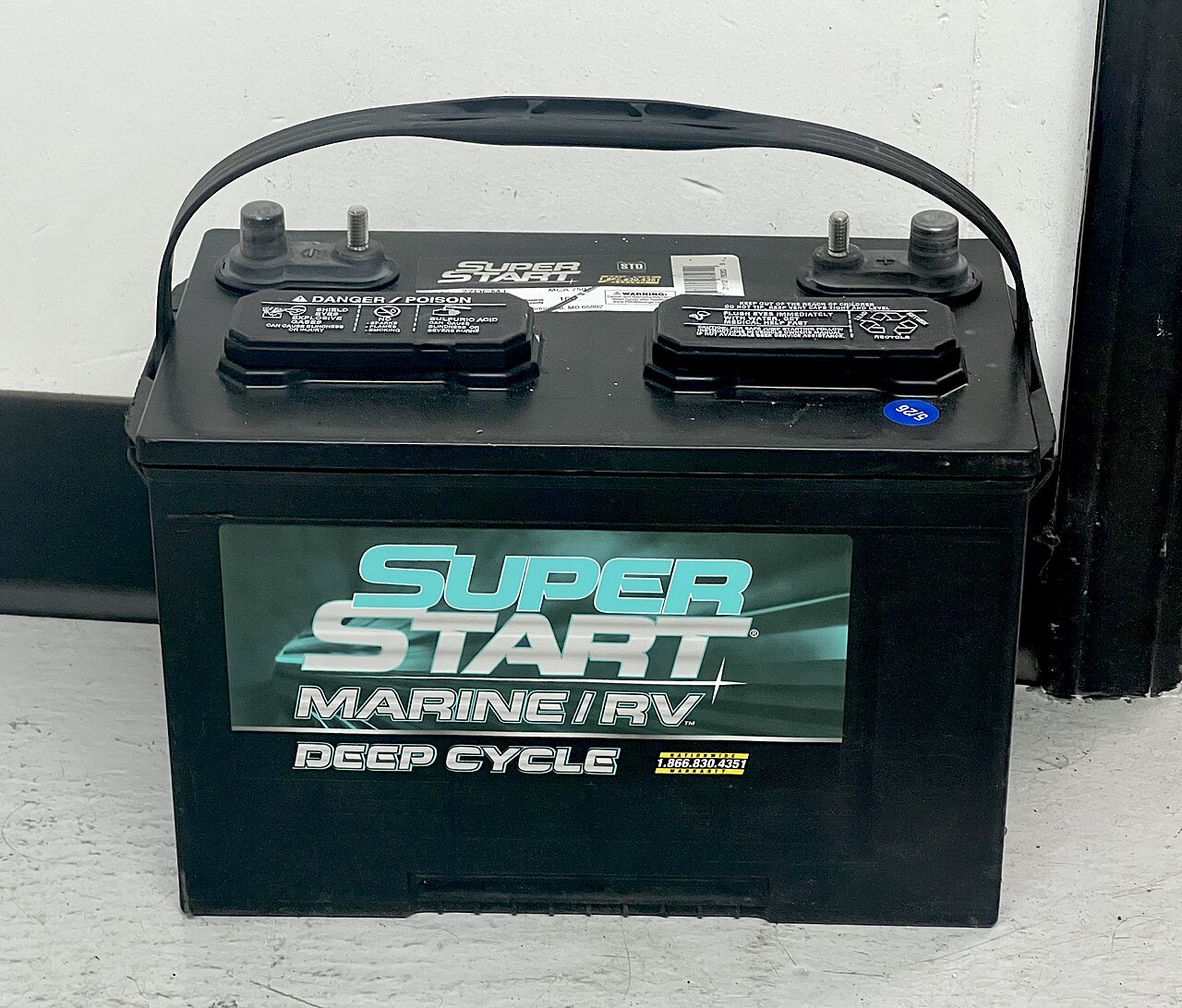
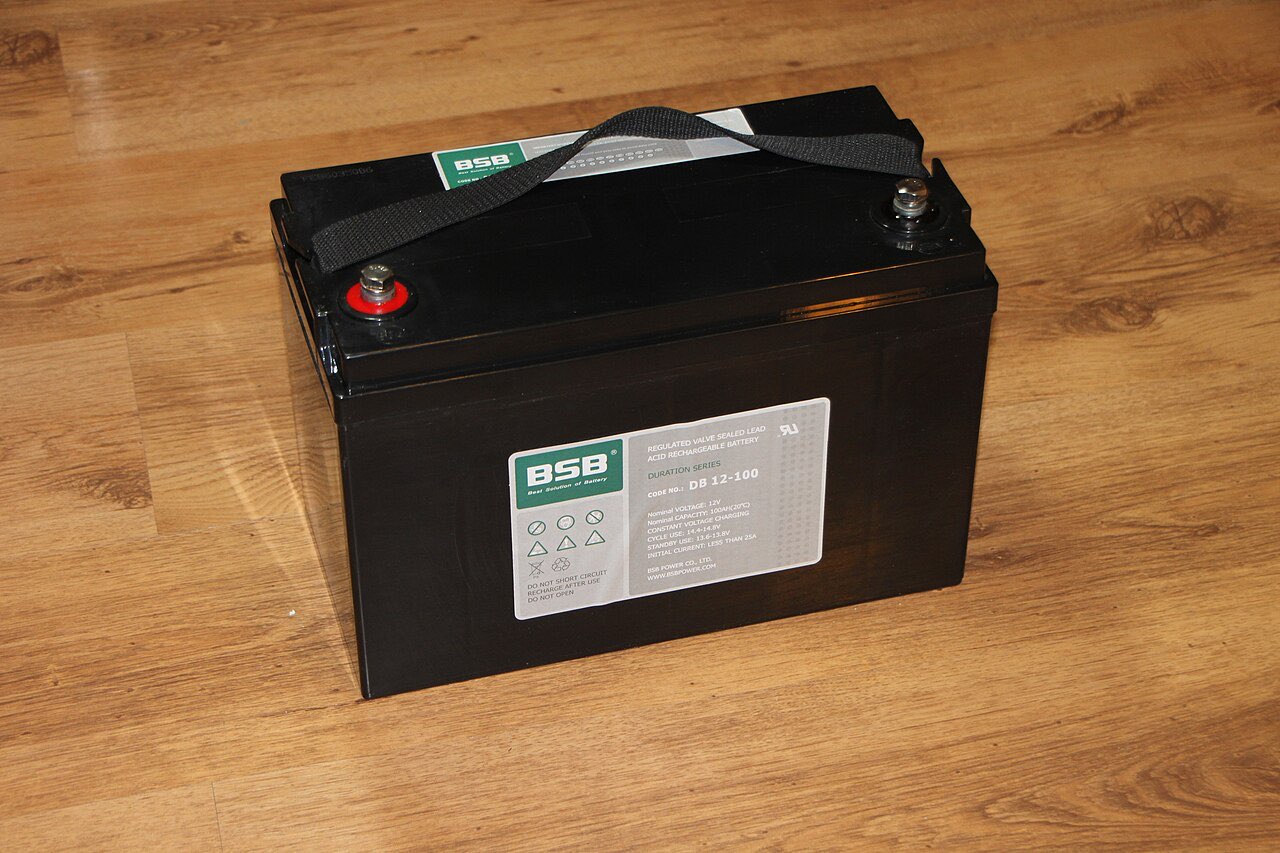
Flooded lead-acid is the oldest and cheapest deep-cycle battery. The cells hold liquid electrolyte under removable caps that you top up with distilled water. Charging releases hydrogen, so they need a vented compartment; Jayco’s manual warns to keep sparks and flames away and to ventilate when charging. Many trailers ship without a battery at all; Jayco’s manual, for example, calls for a customer-supplied Group 27 deep-cycle battery.
AGM (absorbed glass mat) is lead-acid with the electrolyte held in fiberglass mats. It is sealed, spill-proof and maintenance-free, holds its charge better in storage, and costs more than flooded. It has the same usable-capacity limit and roughly the same weight.
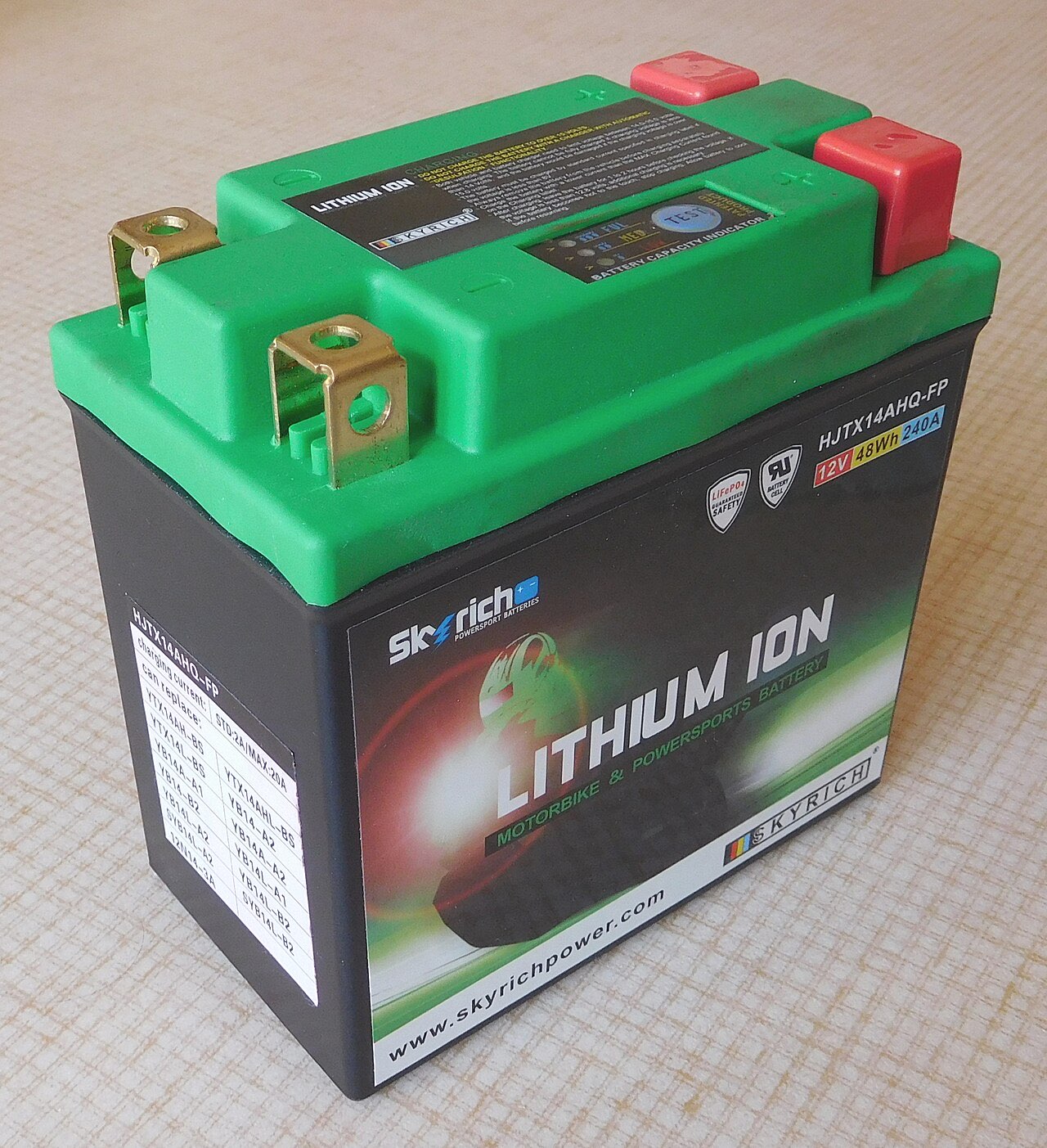
LiFePO4 (lithium iron phosphate) is the lithium chemistry used in RV “drop-in” batteries. Each one contains a battery management system (BMS) that disconnects the battery on over-voltage, under-voltage, over-current or bad temperature. It needs no venting; Battle Born’s spec sheet says its batteries emit no gases and can be mounted in any orientation.
Side by side
| 12 V, 100 Ah class | Flooded lead-acid | AGM (Renogy 100 Ah) | LiFePO4 (Renogy Core 100 Ah) | LiFePO4 (Battle Born BB10012) |
|---|---|---|---|---|
| Listed price, Oct 28, 2026 | Varies; usually the cheapest | $208.99 | $307.99 | $799 sale ($949 regular) |
| Weight | Similar to AGM | 63.9 lb | 21.8 lb | 31 lb |
| Usable capacity | About 50 Ah (stay above 50%) | About 50 Ah (Renogy: do not go below 50%) | Up to 80 Ah at rated cycle life | Up to 100 Ah (Battle Born: to 100% of rated) |
| Rated cycle life | Typically a few hundred at 50% | 500 at 50% depth | 5,000 at 80% depth | 3,000 to 5,000 |
| Maintenance | Water top-ups, venting | None | None | None |
| Charge below freezing | Yes (slowly) | Yes | No: charge range 32 to 122°F | No: not below about 25°F |
| Warranty | Varies | See listing | See listing | 10 years, non-transferable |
Run the per-unit math and the picture is clearer than the sticker prices suggest. Per usable amp-hour, the Renogy AGM costs about $4.18 (208.99 / 50), the Renogy lithium about $3.85 if you use 80 Ah of it, and Battle Born about $8 at its sale price. Per rated cycle, the AGM costs about 42 cents and the Renogy lithium about 6 cents. Battle Born’s premium buys a longer warranty, US assembly in Reno and a long record with RVers, rather than more capacity.
Weight matters too. Two 100 Ah AGM batteries give about 100 Ah usable and weigh about 128 pounds; one 100 Ah lithium gives the same usable energy at 22 to 31 pounds. On a trailer, that difference sits on the tongue and comes out of your truck’s payload. Our towing payload checker shows whether 100 pounds matters for your setup.
How much battery you need
Start with what runs off 12 volts when you are not plugged in. Jayco’s manual gives a worked example: the furnace blower draws about 12 amps and the refrigerator’s 12-volt controls about 3 amps, so with both running constantly, a 75 Ah battery would be fully discharged in 5 hours. Add lights, the water pump, fans, the CO/LP alarm and phone charging, and a cold night on one lead-acid battery runs out before morning.
A rough sizing approach:
- List each 12-volt load and its amps (your manual or the device label).
- Multiply by the hours it runs per day to get amp-hours per day.
- Divide by the usable fraction: 0.5 for lead-acid, about 0.8 to 1.0 for lithium.
- Add a margin for cloudy days or cold nights.
Our RV electrical load calculator does steps 1 and 2. Anything on 120 volts through an inverter costs about ten times its 120-volt amps from the battery, plus inverter losses; that is why a 1,500-watt roof air conditioner is not realistic on batteries alone, as our RV solar basics guide explains.
Charging: the converter question
Your RV’s converter turns shore or generator power into 12-volt power and charges the battery. Lead-acid and lithium want different charging:
- Lead-acid wants a bulk charge, an absorption stage around the mid-14-volt range, then a lower float to hold it full. Renogy lists 14.4 to 14.8 volts for cycle use on its AGM.
- LiFePO4, per Battle Born’s BB10012 spec sheet, wants 14.2 to 14.6 volts absorption for about 30 minutes per 100 Ah, 13.4 to 13.8 volts float, no temperature compensation, and a charge rate up to 0.5C, which is 50 amps per 100 Ah battery.
Many converters built for lead-acid spend most of their time at a lower, float-style voltage. That charges a lithium battery, but slowly, and often not to full. Before switching, find your converter’s model number (usually on the unit in the power center) and check whether it has a lithium mode. If not, lithium-specific converters exist: Progressive Dynamics’ PD9145ALV, for example, is listed at a 14.6-volt output at up to 45 amps. Solar charge controllers also need a lithium profile; most modern MPPT controllers have one.
Two other charge sources to check:
- Tow vehicle 7-way plug. It charges slowly through long, thin wiring. Some owners of large lithium banks add a DC-to-DC charger so the truck’s alternator is not over-worked; ask your truck and battery makers what they recommend.
- Generator. It charges through the same converter, so the converter’s lithium setting matters here too. See RV generator sizing.
Cold weather: lithium’s real limit
LiFePO4 batteries can discharge in the cold, down to about -4°F for both Battle Born and Renogy, but they must not be charged below freezing. Battle Born’s educational series (May 2026) says not to charge below about 25°F unless the battery has internal heating, and its BMS blocks charging outside safe limits. Renogy lists a 32 to 122°F charge range on its Core 100 Ah product page. In practice, a trailer’s battery box on the tongue gets cold overnight in fall and winter, and the BMS will refuse solar or converter charging until it warms.
Options if you camp in the cold:
- Buy a self-heating lithium model, which warms its cells before accepting a charge.
- Mount the batteries inside the heated space, which lithium allows because it does not vent gas.
- Keep an AGM for winter use.
Lead-acid has the opposite cold problem: a discharged lead-acid battery can freeze and crack. Keep it charged in winter. Our winterizing guide covers storage.
Checking state of charge
For lead-acid, resting voltage tells you roughly where you stand. Jayco’s manual lists 12.7 volts as full, 11.89 volts as discharged and 11.65 volts as dead, and warns that going below that can cause irreversible damage.
For lithium, voltage barely changes across most of the range, so a voltmeter is close to useless in the middle. Battle Born’s resting table shows 13.6 volts at 100 percent, 13.2 volts at 70 percent and 13.0 volts at 30 percent: a 0.2-volt swing covering 40 percent of capacity. A shunt-based battery monitor, which counts amps in and out, is the only reliable gauge, and the RV’s built-in LED panel is not one.
Swapping lead-acid for lithium
- Confirm the converter and solar controller can be set to a lithium profile, or budget for replacements.
- Size the cables and fuse for the battery’s maximum current; Battle Born’s is 100 amps continuous per battery.
- Match batteries in a bank. Do not mix chemistries, brands or ages in one bank.
- Torque the terminals to the maker’s spec; Battle Born lists 9 to 11 ft-lb and says not to finger-tighten.
- Store charged. Battle Born recommends storing at 100 percent and disconnecting loads; it self-discharges about 2 to 3 percent a month. Jayco’s manual says to disconnect the negative cable in storage, since some RV equipment draws power even when switched off.
Who each battery suits
- Flooded lead-acid: campers who are almost always on shore power and want the cheapest replacement. Check the water every month.
- AGM: the same campers who want no maintenance, or who camp in sub-freezing weather and charge outdoors.
- LiFePO4: anyone boondocking more than occasionally, anyone running an inverter, anyone with tight payload, and anyone adding solar.
Gear worth a look (affiliate links)
Per the listing, the LiTime 12V 100Ah dual-purpose LiFePO4 battery is a Group 24 lithium battery for both engine cranking and deep-cycle use, marketed mainly for boats, with an IP67 rating and a self-heating feature. Self-heating is the first of the cold-weather options above, but the rule does not change: lithium must not be charged below freezing unless its heater has warmed the cells first, so read the listing for the charge-temperature range and how the heater is powered. Check your converter’s lithium setting first, as in step 1 of the swap list. $377.99Price as of November 16, 2026, 10:00 AM ET. Prices and availability are accurate as of the date/time indicated and are subject to change. Any price and availability information displayed on Amazon.com at the time of purchase will apply to the purchase of this product.
Mistakes to avoid
- Comparing amp-hours across chemistries at face value. A 100 Ah AGM gives about half the usable energy of a 100 Ah lithium.
- Installing lithium and keeping a lead-acid-only converter without checking its voltages.
- Expecting a lithium battery in an outdoor box to charge on a 20°F morning.
- Running a lead-acid battery flat and leaving it there. That damages it quickly.
- Charging lead-acid in a closed compartment without venting.
- Trusting the RV’s LED tank-and-battery panel for lithium state of charge.
Specifications and prices above are as listed by the manufacturers on October 28, 2026. Check the current datasheet for your exact model before you buy or change charger settings.
Frequently asked questions
Is a lithium RV battery worth it over AGM?
For anyone who camps off hookups regularly, usually yes. A 100 Ah lithium iron phosphate (LiFePO4) battery gives you close to 100 Ah of usable power versus about 50 Ah from a 100 Ah AGM you should not drain below half. On Renogy's own pages on October 28, 2026, its 100 Ah AGM was $208.99 and 63.9 lb with 500 cycles at 50 percent discharge, while its 100 Ah LiFePO4 was $307.99 and 21.8 lb rated for 5,000 cycles at 80 percent. If you always camp on shore power, a lead-acid battery is enough.
How much of an RV battery's capacity can I actually use?
Lead-acid batteries, flooded or AGM, should generally not go below about 50 percent charge; Renogy's AGM FAQ says not to discharge below 50 percent, and Jayco's manual calls a lead-acid battery discharged at 11.89 volts. LiFePO4 batteries can be discharged much deeper: Battle Born says its 100 Ah battery can be discharged to 100 percent of its rated capacity. So a 100 Ah lithium battery stores about twice the usable energy of a 100 Ah AGM.
Do I need a new converter for lithium batteries?
Often, or at least a setting change. Many converters built for lead-acid hold a lower voltage most of the time, which can charge a lithium battery slowly and incompletely. Battle Born specifies an absorption voltage of 14.2 to 14.6 volts and float of 13.4 to 13.8 volts. Check whether your converter has a lithium mode; if not, lithium-specific replacements exist, such as Progressive Dynamics' PD9145ALV, listed at 14.6 volts output.
Can lithium RV batteries be charged in freezing weather?
Not standard ones. Battle Born says LiFePO4 batteries should not be charged below about 25°F unless they have internal heating, and its battery management system blocks charging outside safe limits. Renogy lists its Core 100 Ah charge range as 32 to 122°F. Both can still discharge down to about -4°F. For winter camping, choose a self-heating model or mount the batteries inside the heated space.
How long will an RV battery last overnight?
Divide usable amp-hours by your draw. Jayco's manual uses the furnace at about 12 amps plus the refrigerator's 12-volt controls at 3 amps: 15 amps total would empty a fully charged 75 Ah battery in 5 hours. With a 100 Ah AGM (about 50 Ah usable), the furnace running half the night uses most of it. A 100 Ah lithium battery doubles that margin. Our electrical load calculator does this math for your own loads.
How long do RV batteries last in years?
It depends on how deeply and how often you cycle them. Battle Born rates its battery at 3,000 to 5,000 cycles and backs it with a 10-year warranty; Renogy rates its AGM at 500 cycles at 50 percent discharge. A lead-acid battery that is left partly discharged in storage, or allowed to freeze, can be ruined in one season. Lithium batteries also lose only about 2 to 3 percent of their charge per month in storage, per Battle Born.
Keep planning
- How to Use an RV Dump Station Step by Step
How to use an RV dump station: black-then-gray order, hose setup, rinsing, chemicals, where to find free stations, typical fees and what never goes down the drain.
Updated Nov 2026 - RV Sewer Hose Setup: Length, Supports and Fittings
RV sewer hose setup explained: what length to carry, the clear elbow and 4-in-1 adapter, hose supports for a steady downhill run, valve habits and clean storage.
Updated Nov 2026 - RV Gear and Upgrades: Measure Before You Order
Fit guide for RV steps, bunk ladders, windows, shades, hose tubes, tote carriers and vents. Sizes come from the Amazon listings, including where a listing disagrees.
Updated Nov 2026