Boondocking for Beginners: Rules, Water and Power
In this guide
- Where boondocking is legal, and for how long
- How to read a Motor Vehicle Use Map
- Leave No Trace, RV edition
- Water: the budget that ends most trips
- Power: what a battery will and will not run
- Generators: the decibel rule and quiet hours
- Long Term Visitor Areas: the paid version, for winter
- Finding a site
- Gear that actually matters
- Mistakes to avoid
Boondocking means camping with no hookups: no power pedestal, no water spigot, no sewer. Usually it means doing that for free on public land. The rules are simpler than they look: on Bureau of Land Management land you can generally stay 14 days in any 28-day period anywhere not posted closed; in national forests you can stay where the Motor Vehicle Use Map allows, typically 14 days, within a set distance of a mapped road; and everywhere you carry out what you carry in. The hard part is not the rules, it is water and power, and a first weekend with a full fresh tank, a charged battery and no air conditioning will teach you your real consumption numbers.
This guide covers where boondocking is legal and the stay limits, how to read a Motor Vehicle Use Map, Leave No Trace as applied to an RV, how to budget water and electricity for a first trip, generator rules, the paid exception of BLM Long Term Visitor Areas, and the gear that actually matters. Rules are quoted from blm.gov, fs.usda.gov and nps.gov pages as read in October 2026; limits vary by field office and forest, so confirm the local page before you go.
Where boondocking is legal, and for how long
| Land | Who manages it | Default stay limit | Where you may camp | Fee |
|---|---|---|---|---|
| BLM public land | Bureau of Land Management (mostly western states) | Generally 14 days in any 28-day period, then move, often 25 to 30 miles | Anywhere not posted “Closed to Camping,” on existing roads and sites | Free (except developed campgrounds and LTVAs) |
| National forests and grasslands | US Forest Service | Varies: 14 days in 60 (Black Hills), 14 in 30 (Coconino), 16 (Medicine Bow) | Only along roads shown on the MVUM, within the marked distance | Free |
| National parks | National Park Service | Dispersed vehicle camping almost never allowed; campgrounds only | Designated campgrounds | Campground fees |
| State land, water districts, Corps of Engineers | Varies by state and agency | Varies; often permit required | Designated areas | Often a permit fee |
| Private land (farms, wineries, businesses) | Host programs, store parking | Usually one night | Where invited | Membership or free |
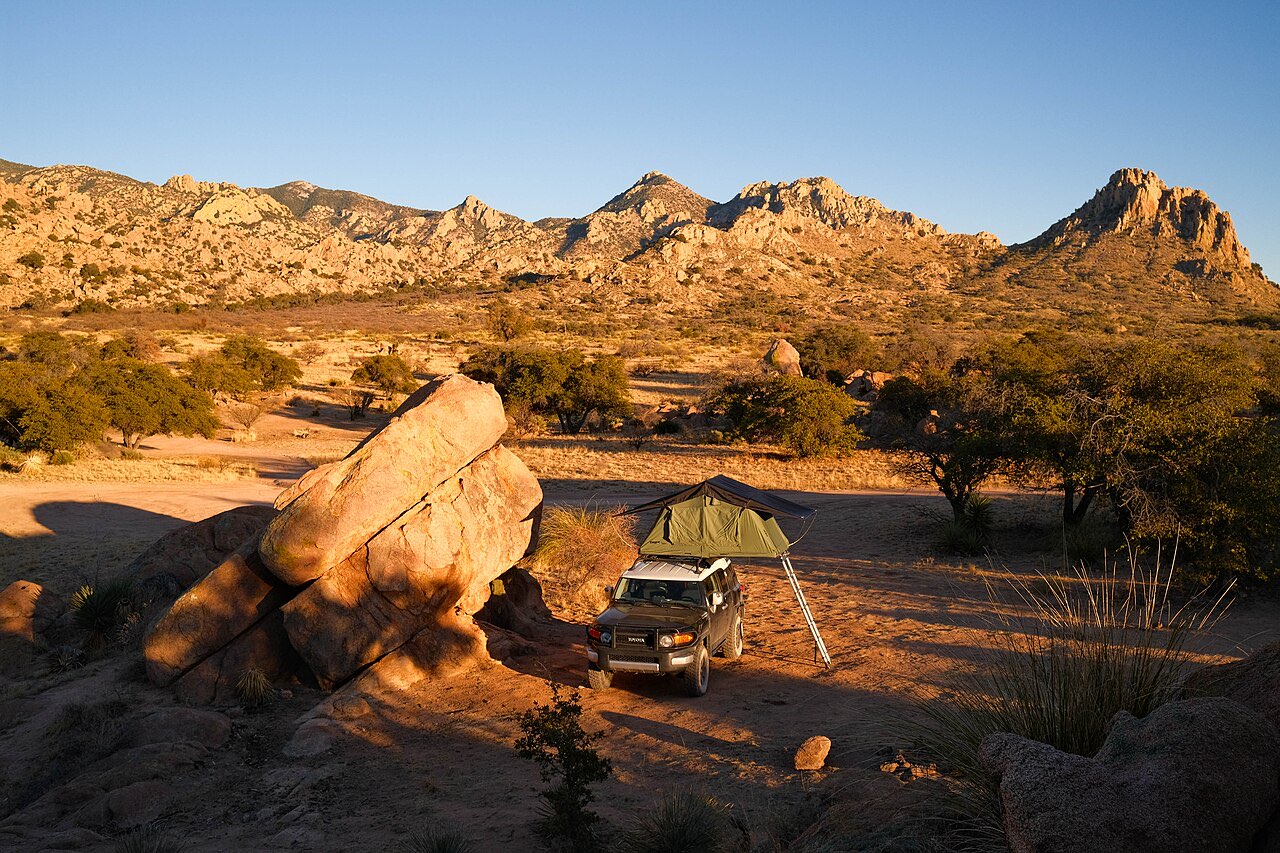
BLM is the backbone of western boondocking. Its camping page states that dispersed camping is “generally limited to 14 days within any 28-day period,” that after reaching the limit you must relocate, “often at least 25 to 30 miles,” that most BLM land allows dispersed camping unless posted closed, that vehicles must stay on designated roads and trails, and that personal property may not be left unattended for more than 10 days. Fire restrictions vary through the year and some regions, California among them, require a campfire permit even for a stove.
National forests are more site-specific. There is no single national rule page; each forest publishes its own. Black Hills National Forest’s dispersed camping page allows a maximum of 14 days in any 60-day period, lets motor vehicles go up to 300 feet off roads shown on the MVUM, requires camping 100 feet from any creek or stream and at least half a mile from developed recreation sites, and bans open campfires in the South Dakota portion. Other forests found in the same search differ: Coconino allows 14 days in a 30-day period and limits off-road parking to 30 feet except in marked corridors up to 300 feet; Coronado uses 14 days in 60; Medicine Bow allows 16; Bighorn requires moving five air miles after 14 consecutive days in summer. The forest’s own page is the only authority.
National parks are the exception people get wrong. With rare backcountry exceptions, you cannot pull off a park road and sleep in an RV. For park trips, the gateway national forest or BLM land outside the boundary is where boondocking happens, and our sister site’s park guides, starting with national park RV size limits, note where those areas are. For the broader menu of where RVs can legally spend a night, including host programs and store lots, see RV camping options compared and is Harvest Hosts worth it.
How to read a Motor Vehicle Use Map
The MVUM is the legal document for driving and camping in a national forest, and it is free. Willamette National Forest’s MVUM page describes it as the map of roads and trails open to motorized travel, identifying which vehicle classes are allowed on each, the dispersed camping corridors, seasonal restrictions and general travel rules, and states the rule that governs everything: “If a Forest Service road or trail is not on this map, public motor vehicle use is prohibited.”
How to use it:
- Download the district PDF from the forest’s website, or load it into the Avenza Maps app, which the Forest Service itself recommends, so your phone shows your position on the legal map without a signal. Carry paper too.
- Find the dispersed camping symbol. Roads where motorized camping is allowed are marked with dots along one or both sides. Where there are no dots, you may drive but not pull off and camp.
- Read the corridor width. The map’s table or legend states how far off the road’s centerline you may park in a corridor, typically 30 feet, 150 feet or 300 feet depending on the forest and the road. Beyond that line, you are driving off-road, which is a citation.
- Check the season. Some roads are closed to motor vehicles in winter or during wildlife seasons; the MVUM lists the dates.
- Use existing sites. Both BLM and Forest Service rules direct campers to existing cleared sites and existing roads. A fire ring and a bare patch mean someone camped there legally before you.
MVUMs are black-and-white and have no topography, so pair them with a visitor map or a satellite layer to judge whether a road is passable for your rig. A road that is legal is not necessarily one a 35-foot fifth wheel can turn around on.
Leave No Trace, RV edition
The National Park Service’s Leave No Trace article lists the seven principles: plan ahead and prepare; travel and camp on durable surfaces; dispose of waste properly; leave what you find; minimize campfire impacts; respect wildlife; be considerate of other visitors. For an RV, the specifics that matter:
- Camp 200 feet from lakes and streams, per NPS guidance, and 100 feet minimum where a forest like Black Hills says so. Water sources are where the damage concentrates.
- No gray water on the ground. The NPS guidance for backpackers is to carry wash water 200 feet from streams and scatter strained dishwater; an RV has a tank, so the standard is higher: everything goes in the gray tank and out at a dump station. Dumping gray water on BLM or Forest Service land is a citable offense in most districts regardless of what a forum told you.
- Black water never leaves the tank until a dump station. Your trip length is set by that tank, not the fresh tank.
- Pack out everything, including toilet paper if anyone uses a cathole (6 to 8 inches deep, 200 feet from water, camps and trails, per the NPS article).
- Fires only where allowed, in an existing ring, dead and down wood only, and out cold. Check the current fire restriction stage; in high restriction stages, generators without spark arrestors and even propane fire pits can be banned.
- Noise and lights. The remote campers around you came for the quiet. Generators off by 10 p.m., exterior lights off at night.
Water: the budget that ends most trips
Nobody runs out of scenery boondocking; they run out of water or fill the gray tank. The EPA’s WaterSense program notes the average American family uses more than 300 gallons of water a day at home, about 70 percent of it indoors. An RV fresh tank is a fraction of that: Winnebago’s Class C floorplans carry 40 to 44 gallons, Grand Design’s Reflection fifth wheels 74 gallons, and many small trailers 20 to 30.
Rough per-person daily use, boondocking with intent:
| Use | Frugal | Comfortable |
|---|---|---|
| Drinking and cooking | 1 gal | 1.5 gal |
| Dishes (basin, not running tap) | 1 gal | 2 gal |
| Toilet (RV flush, foot pedal) | 1 gal | 2 gal |
| Navy shower (wet, off, soap, rinse) | 1.5 gal | 4 gal |
| Hand washing, teeth, misc. | 0.5 gal | 1 gal |
| Per person per day | ~5 gal | ~10 gal |
Two people at the frugal rate use 10 gallons a day: four days on a 40-gallon tank, a week on 74. The gray tank usually fills before the fresh tank empties, because it collects both dishwater and shower water, so check its size too. Ways to stretch it: carry extra fresh water in jerry cans or a bladder, use a basin for dishes and pour it into the gray tank yourself, shower at trailheads or truck stops, and treat the RV shower as a last resort. Fill up at the last campground, rest area or dump station with potable water before you head out, and never from a spigot marked non-potable.
Power: what a battery will and will not run
Off-grid, your 12-volt system runs the lights, water pump, furnace fan, refrigerator controls and USB outlets. Anything 120-volt (microwave, coffee maker, air conditioner, residential refrigerator) needs an inverter drawing from the battery or a generator. The 30 amp vs 50 amp arithmetic still applies: a roof air conditioner draws 1,300 to 2,000 watts, which is beyond any ordinary battery bank for more than a short period and the reason air conditioning is the thing boondockers give up first.
A first-trip power plan:
- Know your battery. A single typical lead-acid or AGM house battery gives roughly 40 to 50 usable amp-hours before it should be recharged; a 100 Ah lithium gives most of its rated capacity. The furnace fan on a cold night can use 30 to 50 amp-hours alone, which is why one lead-acid battery lasts about one cold night.
- Turn off the parasitic loads. Propane detector, stereo memory, TV antenna booster and inverter idle draw add up; find the battery disconnect and learn what it kills.
- Recharge daily. Two options: a portable inverter generator (the 2,000-watt class runs a converter, laptops and a microwave in turn, and an air conditioner only with a soft-start kit), or solar. Our RV solar basics guide sizes a system; the short version is that 200 to 400 watts of panel plus a lithium bank covers everything but air conditioning for most couples in sunny climates.
- Monitor. A shunt-based battery monitor that shows amp-hours in and out is the single most useful boondocking upgrade, because voltage alone lies about lead-acid state of charge.
Generators: the decibel rule and quiet hours
The federal noise standard most often cited is the National Park Service’s, at 36 CFR 2.12(a)(1)(i): operating motorized equipment that exceeds 60 decibels on the A-weighted scale at 50 feet is prohibited in NPS areas, and the same section separately bans noise that is unreasonable considering the time of day. Individual park campgrounds add hour limits; Biscayne National Park’s campground regulations, for example, set quiet hours from 10 p.m. to 6 a.m., ban generator use during them, and restate the 60 dBA at 50 feet limit.
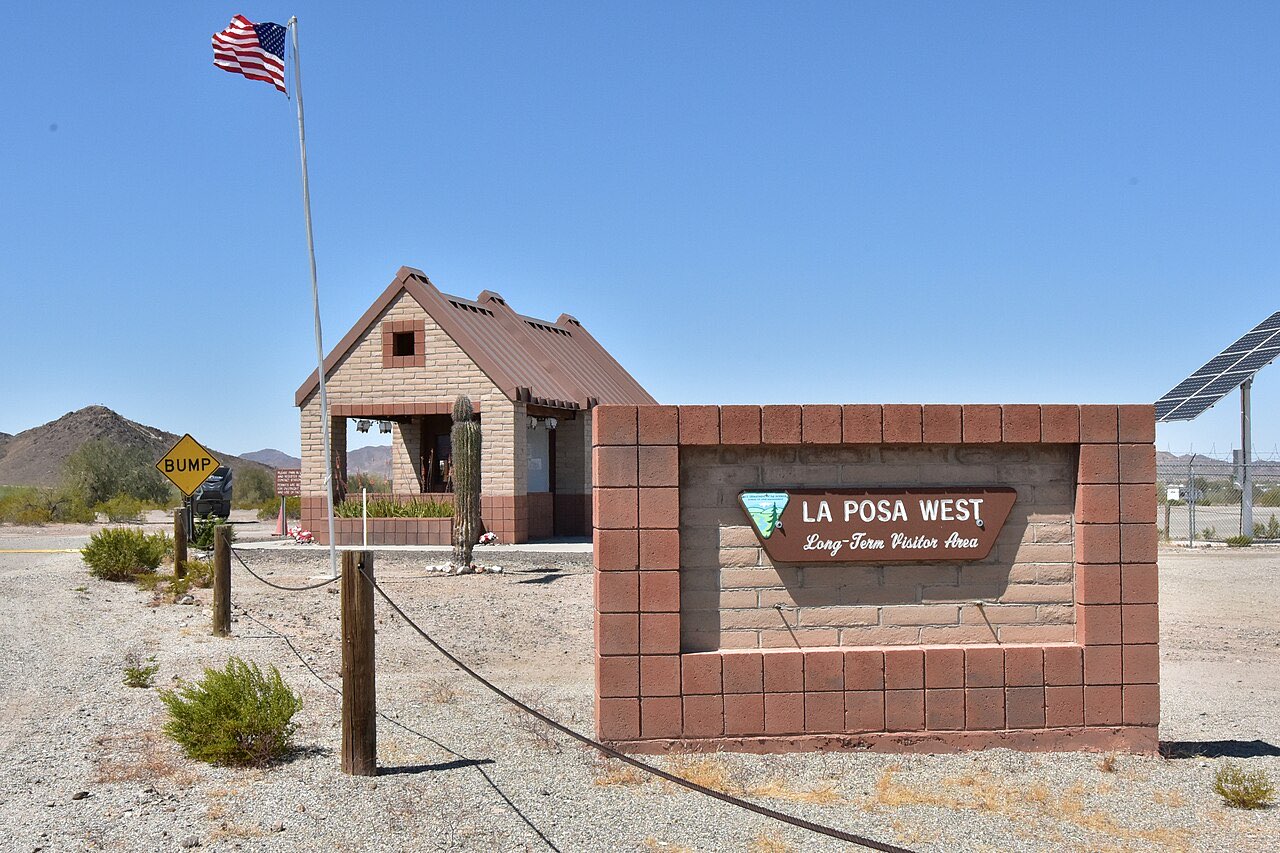
Outside national parks, BLM’s Long Term Visitor Area rules set quiet hours of 10 p.m. to 6 a.m. and prohibit generators operated “in a manner that makes unreasonable noise”; general BLM and Forest Service dispersed areas often post no hours at all, but the LTVA and NPS hours are the norm everyone expects. Practical rules: an inverter generator in the 2,000-watt class is quiet enough at 50 feet to meet the NPS standard at normal load, an open-frame contractor generator is not; point the exhaust away from neighbors and never toward an open window, including your own, because carbon monoxide kills boondockers every year; and run it mid-day, when you can also charge everything at once.
One wiring note for anyone with an energy management system on the shore cord: many portable generators have a floating neutral, which an EMS reads as an open ground and refuses to pass. The fix is a manufacturer-approved neutral-ground bonding plug on the generator, not removing the EMS.
Long Term Visitor Areas: the paid version, for winter
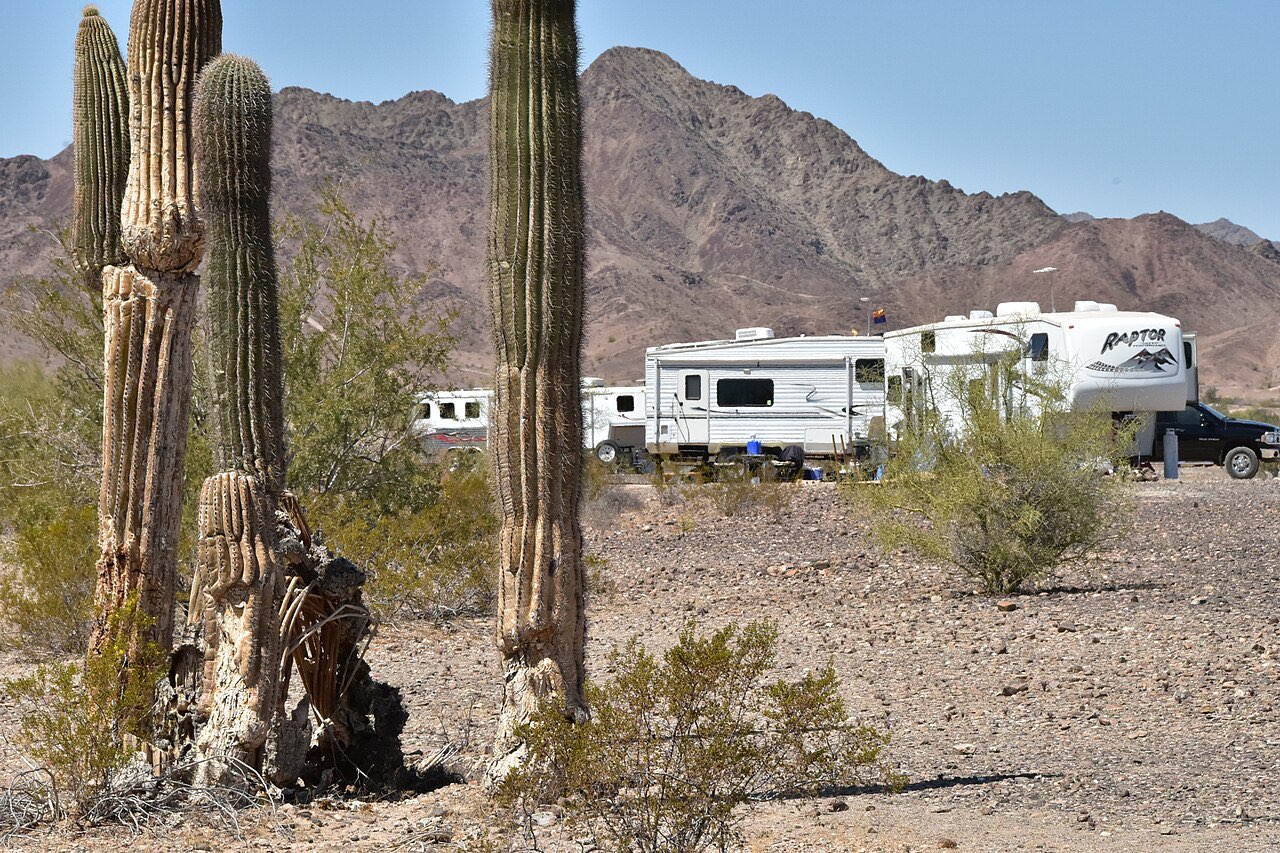
Southwestern Arizona and southeastern California have a different model for the snowbird season. BLM’s Long Term Visitor Areas near Quartzsite, Yuma and the Imperial Dam let you stay far beyond 14 days on a permit. Per the LTVA supplementary rules, permits are required between September 15 and April 15; a long-term permit covers the entire season or any part of it, a short-visit permit covers 14 consecutive days and can be renewed, fees are non-refundable, quiet hours run 10 p.m. to 6 a.m., and units must keep at least 15 feet apart. LTVAs provide water fill, dump stations and trash in return.
Fees are the part to verify before you go. BLM’s Yuma Field Office business plan of September 2024 listed the then-current fees as $180 for the long-term permit and $40 for the 14-day short-visit permit, and proposed raising them to $600 and $200 with a 30-day short permit. As of October 2026 we could not confirm from a BLM release whether that increase has taken effect; secondary reports through mid-2025 still showed $180. Check the BLM Arizona LTVA page for the current season’s fee before planning a winter around it.
Finding a site
Start with the agency, then the apps:
- BLM and Forest Service pages for the area give the rules and often a list of popular dispersed areas with road conditions.
- The MVUM (forests) or BLM travel management map tells you where it is legal.
- Campendium, iOverlander, FreeCampsites.net and The Dyrt list user-reported dispersed sites with recent reviews, cell signal reports and photos of the access road. Our RV campground apps guide compares them.
- Satellite view shows whether the turnaround exists before you commit 30 feet of trailer to a two-track.
Arrive in daylight, walk the last stretch of road if in doubt, and choose an existing site with a hard, level surface rather than creating a new one. A first boondocking trip should be short, close to pavement, in mild weather, and ideally within a half-hour of a dump station and water. Two nights will give you your consumption numbers; after that the planning is arithmetic.
Gear that actually matters
In rough priority order for a first season:
- Battery monitor with a shunt. Knowing your state of charge prevents every other power mistake.
- A second battery or a lithium upgrade. One lead-acid battery is a single cold night.
- Water: extra jerry cans, a dish basin, a low-flow shower head with a shutoff.
- A way to recharge: 200 to 400 watts of solar or a 2,000-watt-class inverter generator with a bonding plug and a long cord.
- Leveling blocks, because dispersed sites are not graded; see how to level an RV.
- Tire repair kit, air compressor and a shovel. Forest roads find weak tires.
- Offline maps (Avenza with the MVUM loaded, downloaded satellite tiles) and a way to call for help where there is no signal.
Nothing on that list is an air conditioner. If summer desert heat is the plan, boondocking means a large generator or a very large battery and inverter system, and most people choose shade and elevation instead.
Mistakes to avoid
- Assuming 14 days means 14 days everywhere. Black Hills counts it in 60 days, Coconino in 30, BLM in 28, and some areas are posted shorter. Read the local page.
- Driving off the MVUM road to find a prettier spot. It is a citation, and it is why corridors get closed.
- Dumping gray water on the ground. Fines, and closures for everyone after you.
- Running the generator at 7 a.m. or 11 p.m. The written rule may not exist on that patch of BLM, but the expectation does, and NPS and LTVA rules say 10 to 6.
- Leaving the rig to “hold the spot.” BLM’s 10-day unattended-property limit exists for this.
- Taking a 35-foot fifth wheel down an unknown two-track. Walk it first, or send the truck.
- Running out of water two days before the stay limit. Budget 5 to 10 gallons per person per day and fill up at the last chance.
Stay limits, distances and fees above are as published on blm.gov, fs.usda.gov and nps.gov in October 2026 and change by field office, forest and season; confirm the local page before you go.
Frequently asked questions
How long can you boondock on BLM land?
The Bureau of Land Management's camping page says dispersed camping is generally limited to 14 days within any 28-day period, after which you must move, often at least 25 to 30 miles. Individual field offices set their own variations, and you may not leave property unattended for more than 10 days. Check the field office page for the specific area before you go.
Is boondocking legal in national forests?
Yes, where the forest's Motor Vehicle Use Map allows it. The MVUM is the legal map: if a road is not on it, driving there is prohibited, and it marks the dispersed camping corridors and how far off the road you may park, often 30 feet or up to 300 feet in marked corridors. Stay limits vary by forest; Black Hills allows 14 days in any 60-day period, Coconino 14 days in 30, and others differ.
How much water do you need per day boondocking?
A careful couple uses roughly 5 to 10 gallons a day for drinking, cooking, dishes and brief navy showers; a family that showers daily can triple that. For context the EPA says an average American household uses more than 300 gallons a day at home. With a 40-gallon fresh tank, typical of a Class C, that is four to eight days; a fifth wheel with a 74-gallon tank stretches to a week or more, limited as much by gray-tank capacity as by fresh water.
Can I run a generator while boondocking?
Usually, within limits. In National Park Service areas 36 CFR 2.12 prohibits motorized equipment louder than 60 decibels at 50 feet, and most campgrounds add quiet hours such as Biscayne's 10 pm to 6 am. BLM Long Term Visitor Areas set quiet hours of 10 pm to 6 am and ban unreasonable generator noise. On general BLM and Forest Service land there is often no posted hour rule, but fire restrictions can ban generators without spark arrestors, and courtesy norms are the same 10 to 6.
Do I need a special RV to boondock?
No. Any RV with holding tanks and a battery can boondock for a weekend. What changes the experience is battery capacity, a way to recharge (solar or generator), and tank sizes. The first upgrade most people make is replacing a single lead-acid battery with a larger bank, then adding solar; air conditioning stays off the table without a large generator or a very large lithium and inverter system.
Keep planning
- 30 Amp vs 50 Amp RV Hookups Explained
30 amp vs 50 amp RV service explained: 3,600 vs 12,000 watts, what runs at once, dogbone adapters, pedestal testing and the voltage limits an EMS enforces.
Updated Oct 2026 - First-Year RV Ownership Costs You Don't See at the Dealer
First-year RV ownership costs beyond the sticker: sales tax, registration, insurance, storage, hitch gear, tires, warranties and depreciation, with official figures.
Updated Oct 2026 - Full-Time RV Living Cost: Monthly Budget by Travel Style
Full-time RV living cost in three monthly budgets, frugal to comfortable, built from official 2026 prices: park and BLM fees, EIA fuel, insurance, Starlink.
Updated Oct 2026