30 Amp vs 50 Amp RV Hookups Explained
In this guide
- The arithmetic: why 50 amp is not “a bit more” than 30
- What runs at once on each
- Which one your RV is, and which one the campground has
- The two dogbone adapters, and what each actually does
- Test the pedestal before you plug in
- Low voltage: the slow killer
- Generators and inverters use the same rules
- Mistakes to avoid
A 30 amp RV hookup gives you 3,600 watts on one 120-volt circuit. A 50 amp hookup gives you 12,000 watts across two 120-volt circuits of 50 amps each. That is the entire difference, and it decides whether you can run two air conditioners, or one air conditioner and a microwave, without walking to the pedestal to reset a breaker. Your RV is one or the other, fixed by the plug on the end of its shore cord; adapters let you connect to the other kind of pedestal but never give you more power than the smaller of the two.
This guide explains the arithmetic, what each service will actually run at once, how the two adapters behave, how to check a pedestal before you plug in, and the voltage and wiring faults a surge protector or energy management system (EMS) is built to catch. The electrical figures come from the National Electrical Code’s Article 551 as summarized by industry code references, and the fault thresholds from Progressive Industries’ EMS instruction manual, as read in October 2026. Campground wiring varies and code editions differ by state, so treat the pedestal in front of you as unknown until you have tested it.
The arithmetic: why 50 amp is not “a bit more” than 30
Power in watts is volts times amps.
| Service | Receptacle | Voltage | Legs | Math | Available power |
|---|---|---|---|---|---|
| 15 amp household | NEMA 5-15, three-prong | 120 V | 1 | 15 x 120 | 1,800 W |
| 20 amp household (GFCI on pedestal) | NEMA 5-20 | 120 V | 1 | 20 x 120 | 2,400 W |
| 30 amp RV | NEMA TT-30, three-prong, round with angled blades | 120 V | 1 | 30 x 120 | 3,600 W |
| 50 amp RV | NEMA 14-50, four-prong | 125/250 V | 2 | 2 x 50 x 120 | 12,000 W |
The 50 amp receptacle has two hot blades, a neutral and a ground. Each hot is a separate 120-volt leg with its own 50 amp breaker; the RV’s distribution panel puts some circuits on leg one and some on leg two. Measured between the two hots there is 240 volts, which is why code labels it 125/250-volt, but almost no RV has a 240-volt appliance. It simply has twice the 120-volt capacity of a 30 amp rig, on a 50 amp rather than 30 amp breaker, which is how the gap works out to more than three times the power.
The practical ceiling is lower than the nameplate. Breakers are not meant to carry their full rating continuously, so plan around roughly 80 percent: about 2,900 watts on 30 amp and about 4,800 watts per leg on 50 amp.
What runs at once on each
Appliance draws vary by model; these are typical ranges to check against the label on your own equipment.
| Load | Typical running draw |
|---|---|
| Roof air conditioner, 13,500 BTU | 1,300 to 1,700 W (higher for a few seconds at compressor start) |
| Roof air conditioner, 15,000 BTU | 1,500 to 2,000 W |
| Microwave | 1,000 to 1,500 W |
| Electric water heater element | about 1,400 W |
| Converter / charger topping up batteries | 300 to 800 W |
| Residential refrigerator | 150 to 400 W running |
| Coffee maker, toaster, hair dryer, space heater | 900 to 1,800 W each |
On 30 amp (about 2,900 W working budget): one air conditioner (1,500 W) plus the converter (400 W) leaves roughly 1,000 watts. Switch the water heater to propane, run the microwave only with the air conditioner cycled off, and never add a space heater or hair dryer on top of the air conditioner. A second air conditioner is out of the question.
On 50 amp (about 4,800 W per leg): two air conditioners on separate legs, the microwave, the water heater element and the converter all at once, with headroom. The only common way to trip a 50 amp rig is to stack several heating appliances on the same leg; if that happens, move one of them to an outlet fed by the other leg.
If you are not sure which legs your outlets are on, the panel directory in the RV usually says, and a plug-in watt meter on each circuit confirms it in an afternoon.
Which one your RV is, and which one the campground has
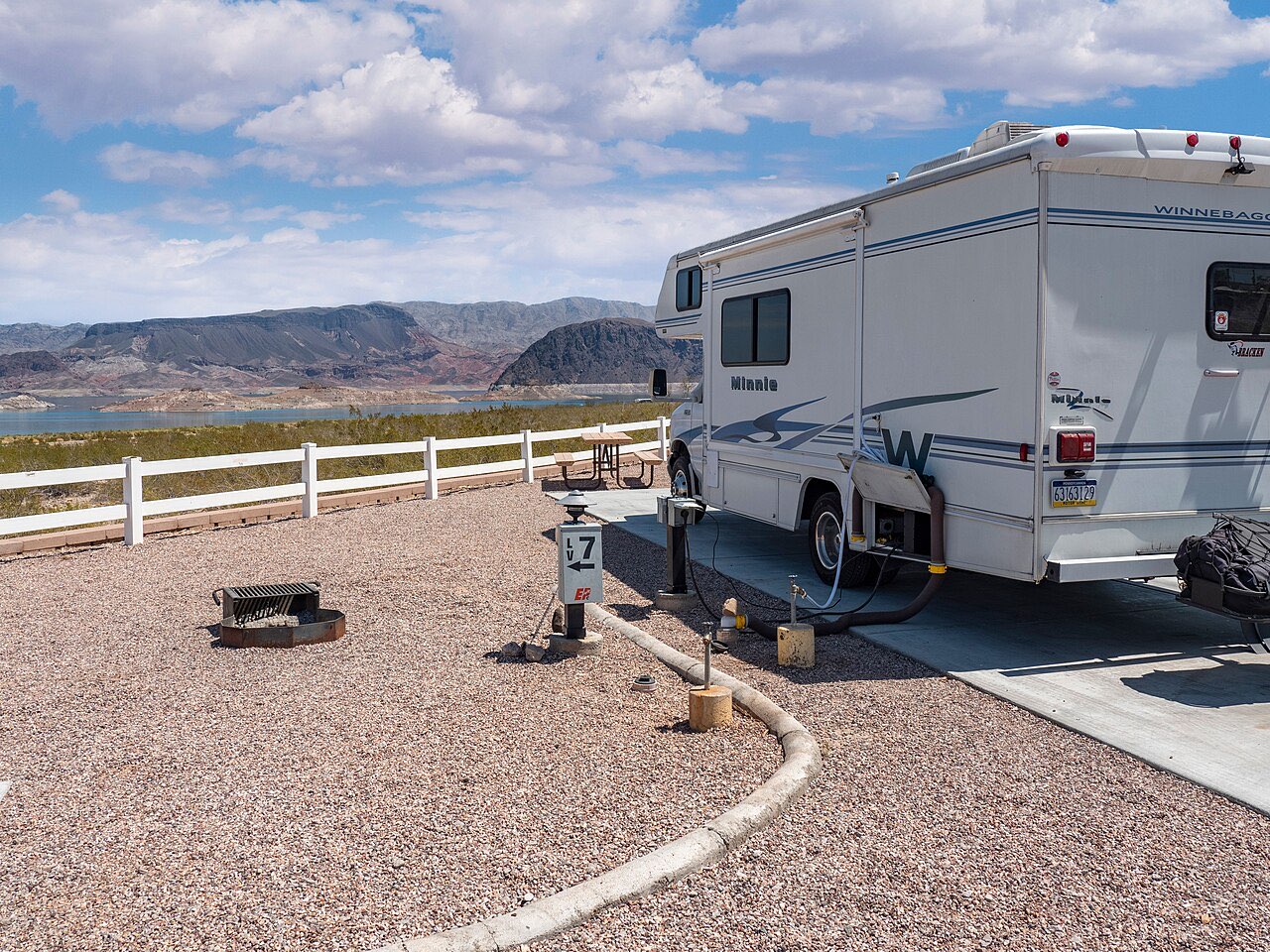
Look at the plug on your shore cord. Three prongs in a round pattern with two angled blades is 30 amp (TT-30). Four prongs is 50 amp (14-50). Smaller trailers, most Class B vans and most Class C motorhomes with one air conditioner are 30 amp; larger travel trailers, nearly all fifth wheels and most Class As with two or more air conditioners are 50 amp.
Campgrounds are built to NEC Article 551, which sets minimums for how many sites get which receptacle. As summarized by the EC&M code reference and Leviton’s Captain Code notes on section 551.71:
- At least 70 percent of RV sites with electrical supply must have a 30 amp, 125-volt receptacle.
- At least 20 percent must have a 50 amp, 125/250-volt receptacle (later code cycles raise this for new parks, with summaries citing 40 percent of new sites).
- Every site must also have at least one 20 amp, 125-volt receptacle, GFCI-protected.
- Since the 2014 cycle, every site equipped with a 50 amp receptacle must also have a 30 amp receptacle, a change made specifically to discourage “cheater” adapters that ignored the supply circuit’s rating.
The adopted edition and local amendments vary by state and by when the park was built, so an older park may have a smaller share of 50 amp sites and more worn 30 amp receptacles. Booking sites and apps list the service per site; our RV campground apps guide covers which ones show it reliably, and our sister site lists national park campgrounds with hookups, which are mostly 30 amp or 50 amp at a small number of loops.
The two dogbone adapters, and what each actually does
A “dogbone” is a short cable with a different plug at each end. There are two you will meet, and they behave very differently.
50 amp RV into a 30 amp pedestal (adapter: 30 amp male to 50 amp female). The adapter bridges the single 30 amp hot to both of the RV’s legs. You get 30 amps total, about 3,600 watts, shared across the whole coach. Camco’s PowerGrip version is rated at 125 volts and 3,750 watts. The pedestal’s 30 amp breaker is now the limit, not your 50 amp main, and it will trip when you forget and start the microwave with an air conditioner running. This is the normal situation for a 50 amp rig in an older state park, and it is workable if you manage loads like a 30 amp owner.
30 amp RV into a 50 amp pedestal (adapter: 50 amp male to 30 amp female). The adapter takes one of the two 50 amp hots and feeds it to your single 30 amp line. Your RV’s own 30 amp main breaker still protects everything downstream, so nothing is overloaded and you gain nothing. It is useful when the pedestal’s 30 amp socket is burned or loose, which is common, and the 50 amp socket is fresh.
Two rules for either adapter:
- Never daisy-chain adapters to reach a household 15 or 20 amp outlet for anything more than keeping batteries topped up. A 15 amp outlet is 1,800 watts and the household wiring behind it was not designed for a continuous RV load.
- Heat is the warning sign. Check the adapter and the plug ends by hand after the first hour. A warm plug is normal; one too hot to hold means a worn contact and a fire risk, and the receptacle or the adapter needs replacing.
Test the pedestal before you plug in
A pedestal can be wired wrong, worn, or running on low voltage because the park’s transformer is overloaded on a hot afternoon. None of these are visible. A plug-in circuit tester with a voltmeter costs little; an EMS costs more and does the testing continuously.
A manual check in order:
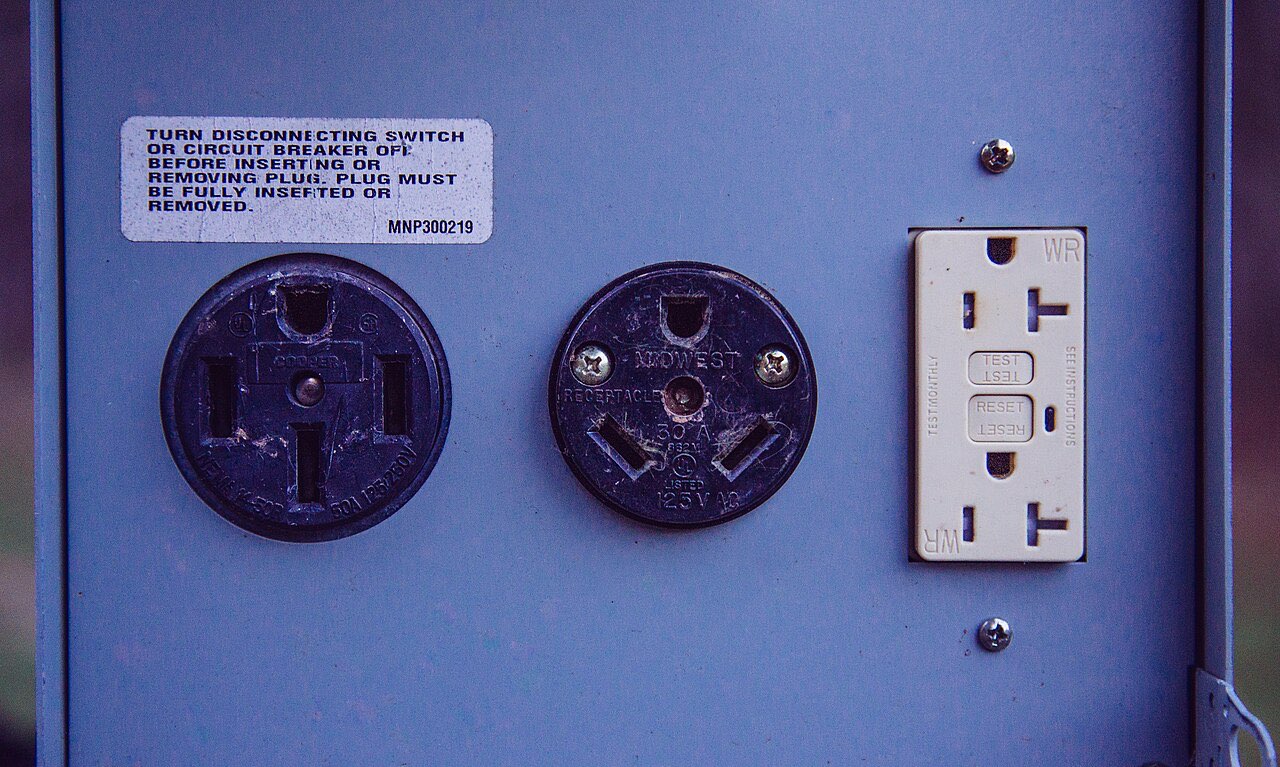
- Breaker off at the pedestal. Most pedestals carry the warning in the photo above: turn the disconnect off before inserting or removing the plug, and insert it fully.
- Look. Scorch marks, melted plastic or a loose receptacle mean choose another site.
- Voltage. Hot to neutral should read roughly 108 to 128 volts on each leg. Under about 104 volts, do not run air conditioners; ask for another site.
- Polarity and ground. A plug-in tester shows an open ground, open neutral or reversed hot and neutral with its light pattern. Any of these: do not connect.
- Plug in, then breaker on. Reverse the order to disconnect.
An EMS automates all of this and keeps watching. Progressive Industries’ instruction manual for its portable EMS units states the thresholds it enforces: power is cut when voltage drops below 104 volts for more than six seconds or rises above 132 volts, and is restored automatically after a 2 minute 16 second (136 second) delay once the line recovers, which also protects the air conditioner compressor from short-cycling. Its fault codes are worth knowing because they tell you what is wrong with the pedestal:
| Code | Fault | What to do |
|---|---|---|
| E1 | Reverse polarity (hot and neutral swapped) | Report to the office; move sites |
| E2 | Open ground | Report; move sites |
| E3 / E4 | Line 1 voltage above 132 V / below 104 V | Wait or move; do not run A/C on low voltage |
| E5 / E6 | Line 2 high / low (50 amp units) | Same |
| E7 / E8 | Frequency above 69 Hz / below 51 Hz | Usually a generator problem |
| Display dark | Open neutral | No power is passed; do not bypass |
The manual’s open-neutral note matters most on 50 amp: if the neutral fails, the two legs can see wildly unbalanced voltage, and 120-volt appliances on one leg can be fed something closer to 240 volts. That is the single most destructive campground fault, and it is the reason a 50 amp rig in particular should never plug in without protection. Our RV surge protector basics guide covers the difference between a simple surge suppressor, which only absorbs spikes, and an EMS, which also disconnects on voltage and wiring faults.

Low voltage: the slow killer
Air conditioners are induction motors. When supply voltage sags, the compressor draws more current to deliver the same work, runs hotter, and its start capacitor and windings age faster. A park that reads 118 volts at 9 a.m. can read 105 at 4 p.m. when every site’s air conditioner is on, and 30 amp sites on long runs of undersized wire sag the most. An EMS’s 104-volt cutoff is there to stop the compressor before it cooks; without one, the symptom is an air conditioner that “just died” in its third summer. If voltage is chronically low, run one air conditioner instead of two, pre-cool the coach in the morning, and report it; parks can and do rebalance transformer loads.
Generators and inverters use the same rules
Off-grid, the same 30 and 50 amp plugs appear on the other end of a generator cord. Winnebago’s Class C motorhomes, for instance, ship with a 4,000-watt onboard generator, which comfortably feeds a 30 amp coach but could not supply a 50 amp coach’s full 12,000 watts; a built-in transfer switch simply delivers what the generator has. Portable inverter generators in the 2,000-watt class will run a 30 amp rig’s air conditioner only with a soft-start device and little else, which is why our boondocking for beginners guide treats air conditioning off-grid as a luxury rather than a baseline. Two generator-specific notes from the EMS manual: an RV keeps neutral and ground separate, and some portable generators have an unbonded neutral that makes an EMS report an open ground. The fix is a manufacturer-approved neutral-ground bonding plug on the generator, not bypassing the EMS. Solar and a lithium bank, covered in RV solar basics, feed the same 120-volt circuits through an inverter, with the inverter’s rating as the new ceiling.
Mistakes to avoid
- Buying a 50 amp rig and assuming every park has 50 amp. Code only requires 20 percent of sites, and older parks are mostly 30 amp. Carry the 30-to-50 dogbone from day one.
- Treating the adapter as a power upgrade. The pedestal breaker is always the limit.
- Plugging in with the pedestal breaker on. Arcing on insertion is what pits and burns receptacles.
- Bypassing an EMS that refuses to pass power. It is refusing for one of the reasons in the code table above, and every one of them can destroy equipment or hurt someone.
- Running two air conditioners on a 30 amp adapter “just for a minute.” It trips the pedestal every time, and repeated tripping wears the breaker for the next camper.
- Ignoring a hot plug. Heat means resistance, resistance means a failing contact.
Code requirements and product thresholds above are as published in October 2026; confirm the NEC edition your state has adopted if you are wiring a pedestal at home, and read your own EMS manual for its exact cutoffs.
Frequently asked questions
How many watts is a 30 amp RV hookup?
3,600 watts. A 30 amp RV outlet is a single 120-volt circuit, and 30 amps times 120 volts is 3,600 watts, with a safe continuous working figure closer to 2,900 watts. That is enough for one roof air conditioner plus the converter and a few small loads, but not for a second air conditioner or an air conditioner and a microwave together.
How many watts is a 50 amp RV hookup?
12,000 watts. A 50 amp RV outlet is a 125/250-volt, four-wire connection that delivers two separate 120-volt legs of 50 amps each. The RV splits its circuits across the two legs, so the total available is 2 x 50 x 120 = 12,000 watts, more than three times a 30 amp site. The RV does not actually use 240 volts; it uses the two 120-volt halves.
Can I plug a 50 amp RV into a 30 amp outlet?
Yes, with a 30 amp male to 50 amp female dogbone adapter, but you only get 30 amps total, about 3,600 watts, shared across both of the RV's legs. Camco rates its version at 125 volts and 3,750 watts. You will need to manage loads manually: one air conditioner at a time, no microwave while the water heater element is on, and expect the pedestal breaker to trip if you forget.
Can I plug a 30 amp RV into a 50 amp outlet?
Yes, with a 50 amp male to 30 amp female adapter. The RV's own 30 amp main breaker still protects it, so you do not get extra power and nothing is overloaded. It is the right move when the 30 amp receptacle on a pedestal is worn or scorched and the 50 amp one is in better shape.
What voltage is too low for an RV?
Below about 104 volts. Progressive Industries' EMS manual shuts power off when voltage stays under 104 volts for more than six seconds or rises above 132 volts, then restores it after a 136-second delay once the line recovers. Low voltage makes air conditioner compressors draw more current and run hot, which is how campground brownouts shorten their life.
Why does my surge protector show an open ground or reverse polarity error?
Because the pedestal is miswired, and the device is doing its job by refusing to pass power. In Progressive Industries' code list E1 is reverse polarity (hot and neutral swapped), E2 is open ground, and an open neutral leaves the display dark. Report it to the campground office and ask for a different site rather than bypassing the protector.
Keep planning
- How to Use an RV Dump Station Step by Step
How to use an RV dump station: black-then-gray order, hose setup, rinsing, chemicals, where to find free stations, typical fees and what never goes down the drain.
Updated Oct 2026 - Boondocking for Beginners: Rules, Water and Power
Boondocking for beginners: BLM and Forest Service dispersed camping rules, 14-day limits, Motor Vehicle Use Maps, Leave No Trace, water and power budgets.
Updated Oct 2026 - First-Year RV Ownership Costs You Don't See at the Dealer
First-year RV ownership costs beyond the sticker: sales tax, registration, insurance, storage, hitch gear, tires, warranties and depreciation, with official figures.
Updated Oct 2026