RV Tire Age, Pressure and When to Replace
In this guide
RV tires fail from age and underinflation far more often than from wear. The three numbers that matter are the build date molded into the sidewall (replace at six years per Goodyear, ten at the outside per Michelin), the load on each tire (weigh it), and the cold pressure that load requires (look it up in the maker’s table, or run the sidewall maximum on a trailer). A tire pressure monitor on every wheel, including the trailer, is how you find out about a problem before the tread leaves the carcass.
This guide covers how to read the DOT date code, what the tire makers actually say about age, how load/inflation tables work with a worked example, what the law requires and does not require for TPMS, and the ST-versus-LT question for towables. Sources are federal regulations at law.cornell.edu, Michelin’s RV service-life bulletin, Goodyear’s published Endurance load table and tire-life guidance, all read October 28, 2026.
Reading the DOT code
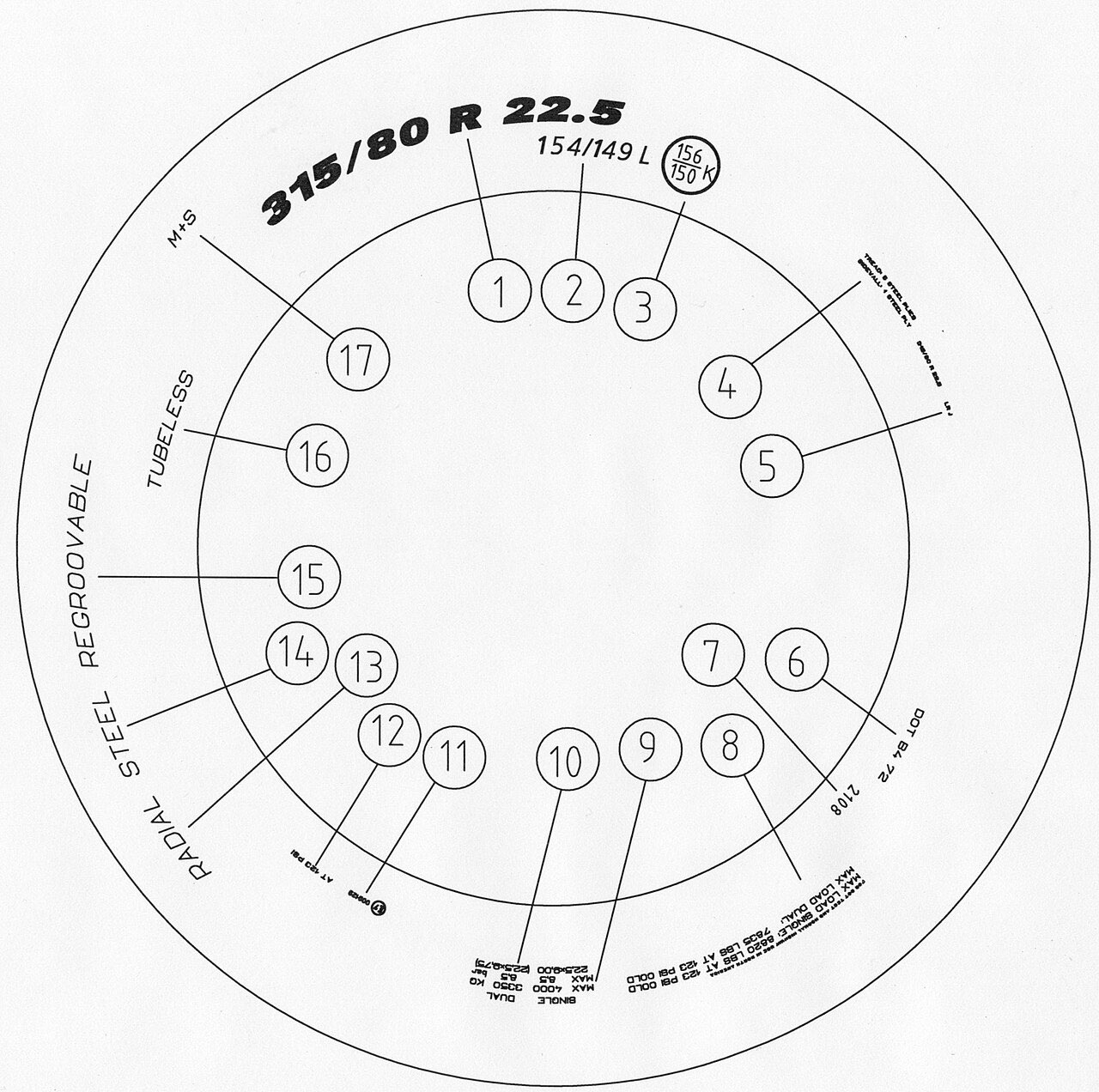
Every tire sold in the US carries a Tire Identification Number that starts with the letters DOT. Under 49 CFR 574.5, the code runs: a three-character plant code, a six-character manufacturer’s code, and then a date code “consisting of four numerical symbols” as the final group. The first two digits are the week, numbered from “01” for the first full calendar week of the year, and the last two are the year. So a tire ending 1823 was built in the 18th week of 2023, early May. Michelin’s bulletin uses the example 0316, third week of 2016.
Two traps. First, the regulation requires the full TIN on only one sidewall; the other side often shows only the plant and manufacturer codes, with no date. If you see a code ending in letters, look at the other side of the tire, which on a trailer may mean crawling under it with a flashlight. Second, tires made before 2000 used a three-digit date code; if you find one of those on a trailer you are buying, the tires are not a negotiating point, they are scrap.
Write the date of every tire, including the spare, on a card in the glovebox. Spares age at the same rate and are the tire most likely to be original on a ten-year-old rig.
How old is too old
There is no federal expiration date on tires. The guidance comes from the manufacturers, and the two biggest disagree on the number while agreeing on the logic.
Goodyear: its tire-life page recommends that any tire in service six years or more, including the spare, be replaced even if it appears serviceable and has legal tread. If the in-service date is unknown, use the DOT date, and remove any tire manufactured more than six years ago.
Michelin: its technical bulletin on RV and motorhome tire service life (2006, revised 2018) says any tire, spares included, should be replaced after 10 years of service even if it has not reached the legal wear limit, that tires in use five years or more should be inspected by a specialist at least annually, and that original-equipment tires follow the vehicle maker’s interval but never beyond 10 years. The same bulletin says it is impossible to predict replacement from calendar age alone, because load, speed, inflation, heat and storage all change the rate.
How to use those two numbers:
| Tire | Realistic service life | Why |
|---|---|---|
| ST tires on a travel trailer or fifth wheel | 4 to 6 years | Loaded near capacity, parked in sun, flexed by sway and tight turns; cracking shows early |
| LT tires on a Class C, Class B or truck camper chassis | 6 to 7 years | Lighter duty cycle, often driven more, which helps |
| 19.5- and 22.5-inch tires on a Class A | 7 to 10 years with annual inspection from year 5 | Heavier construction; this is the tire Michelin’s bulletin is written for |
| Any spare | Same clock as the rest | Age, not mileage, is the limit |
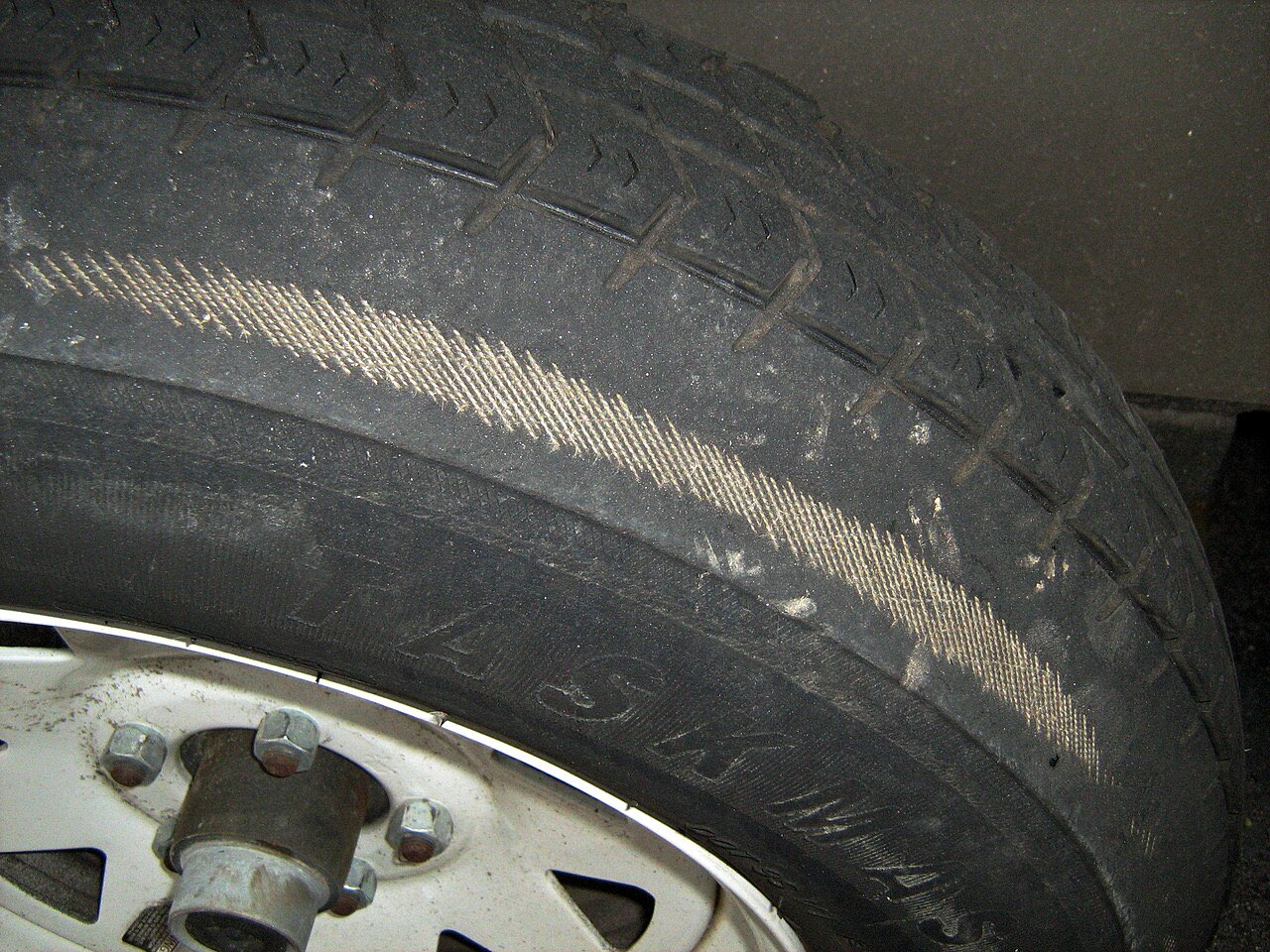
Inspect for sidewall cracking between the treads and at the bead, bulges, exposed cord on the inside sidewall (the side you never see), and a tread that is worn at both shoulders but not in the center, which means chronic underinflation. Any of those ends the discussion regardless of date.
Weight first, then pressure
Tire pressure is not a number you pick; it is the pressure the load requires. The process:
- Weigh the rig loaded for travel. A CAT scale pass gives you per-axle weights for $15.25. Because side-to-side loads differ (slides, tanks, generator), the makers recommend weighing each axle end separately where possible; the RV Safety and Education Foundation does that at rallies.
- Find the heavier end of each axle. Divide the axle weight by the number of tires on it if you only have axle totals, and add a margin for the heavy side.
- Open the tire maker’s load/inflation table for your exact size and load range. Goodyear, Michelin, Bridgestone and others publish them. Find the column where the load per tire is equal to or greater than yours; that column’s pressure is the minimum cold pressure. Never pick the pressure for a load lower than yours.
- Add a margin. Five to ten percent, or 5 psi, so that a cold morning does not put you under. Do not exceed the wheel’s rated pressure or the sidewall maximum.
- Set every tire on the axle to the same pressure, the one the heavier side needs.
A worked example from Goodyear’s Endurance table
Goodyear’s published load/inflation table for Endurance ST tires (dated June 2017; Goodyear’s site is the current version) lists, for the common ST225/75R15:
| Cold psi | 25 | 35 | 45 | 50 | 55 | 60 | 65 | 70 | 80 |
|---|---|---|---|---|---|---|---|---|---|
| Load per tire, lb | 1,430 | 1,760 | 2,020 | 2,150 | 2,270 | 2,380 | 2,540 | 2,620 | 2,830 (E) |
A tandem-axle travel trailer scales at 6,900 lb on its axles, loaded. That is 1,725 lb per tire if the weight were even; assume the heavy side carries 1,850. The table says 1,850 is covered at 45 psi (2,020 lb). A Load Range D version of that tire tops out at 65 psi and 2,540 lb; running the sidewall maximum of 65 psi gives a 37 percent reserve. That reserve is why trailer owners run the maximum: it costs a slightly harsher ride and buys heat and sway margin.
For the same trailer on ST235/80R16 Load Range E, the table runs 1,720 lb at 25 psi to 3,000 lb at 65 psi and 3,420 lb at 80 psi. At 1,850 lb per tire, 30 psi would technically carry it, but no one should run an E-range trailer tire at 30 psi; the sidewall maximum, with the matching wheel, is the practical answer.
Motorhomes are different. A Class A on 22.5-inch tires has a placard pressure that assumes maximum axle load; weighing often shows the front axle well under its rating, and the table then allows a lower front pressure that transforms the ride. That is the one case where “less than the sidewall” is correct, and only after weighing.
Cold means cold
Every table and every placard is a cold inflation pressure: set before driving more than a mile, before the sun has been on the tires. Pressure rises 10 to 15 percent in an hour of highway driving and that rise is designed in; never bleed a hot tire down to the cold number. Pressure also falls with air temperature, roughly 1 psi per 10°F, so a tire set in a 90°F August afternoon is several psi low on a 40°F October morning, and a trailer left at summer pressure through a northern winter can be 10 psi down by spring. Check monthly in storage and before every trip. On a motorhome, check the inside duals; they are the ones that run low unnoticed and overload their outer partner.
TPMS: what the law requires and what you should add
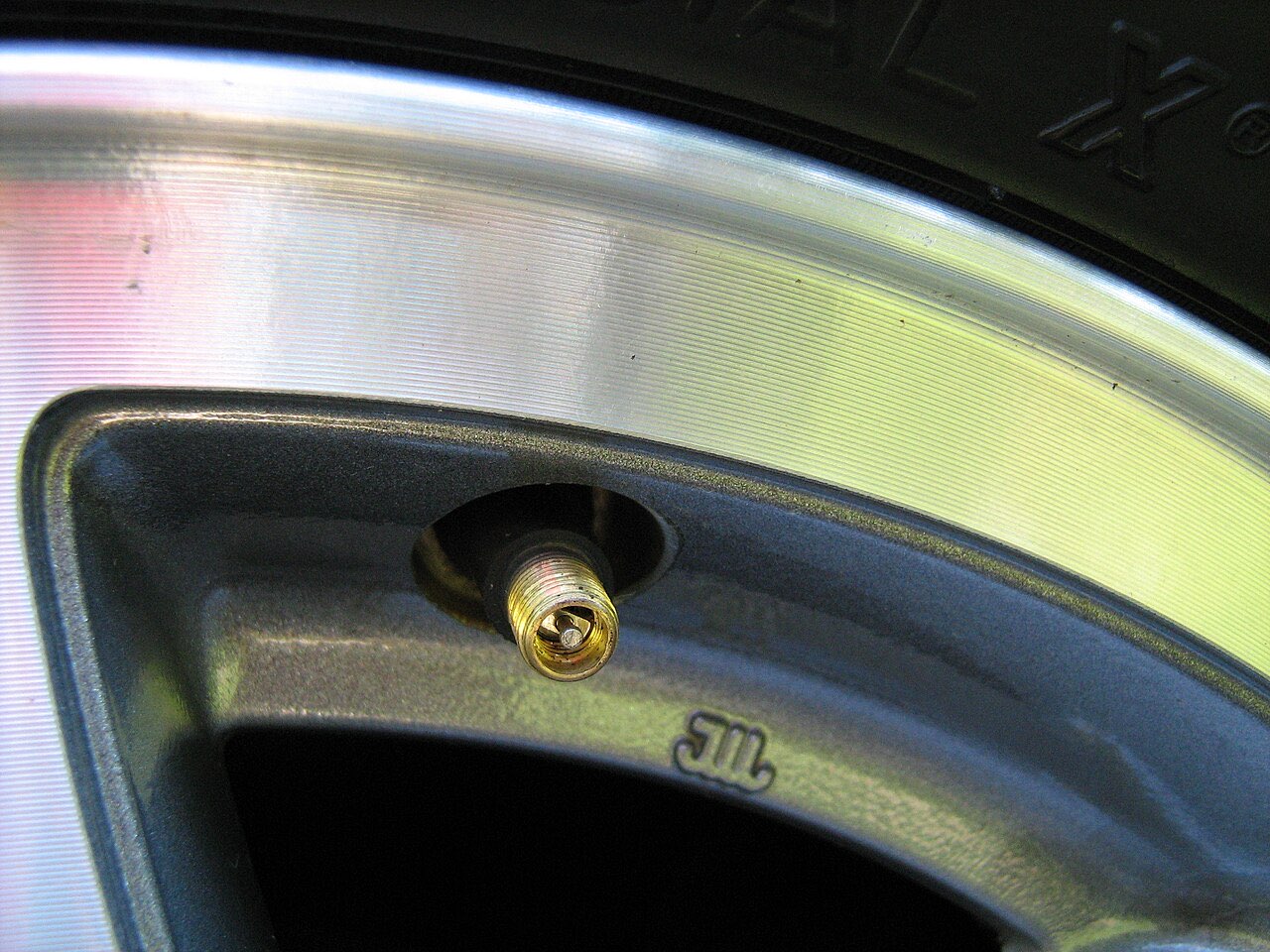
Federal standard FMVSS 138 requires a tire pressure monitoring system on passenger cars, multipurpose vehicles, trucks and buses with a GVWR of 10,000 lb or less, “except those vehicles with dual wheels on an axle.” The warning must light when any tire is 25 percent below the manufacturer’s recommended cold pressure, within 20 minutes of reaching it. The same rule requires the owner’s manual to tell you to check each tire, including the spare, monthly when cold.
Read that scope against the RV fleet:
- A half-ton or three-quarter-ton tow vehicle: TPMS fitted. A one-ton dually: exempt, usually no TPMS from the factory.
- A Class B or small Class C on a van chassis under 10,000 lb: fitted. Most Class Cs are over 10,000 lb or on dually axles: no TPMS.
- Every travel trailer and fifth wheel: not covered. Nothing on the dash tells you a trailer tire is losing air.
A 25 percent warning threshold is also late. A trailer tire at 65 psi placard will not trigger until 49 psi, by which time it has been running hot for miles. Aftermarket systems let you set your own low and high limits and a temperature alarm, which catches a dragging brake as well as a leak.
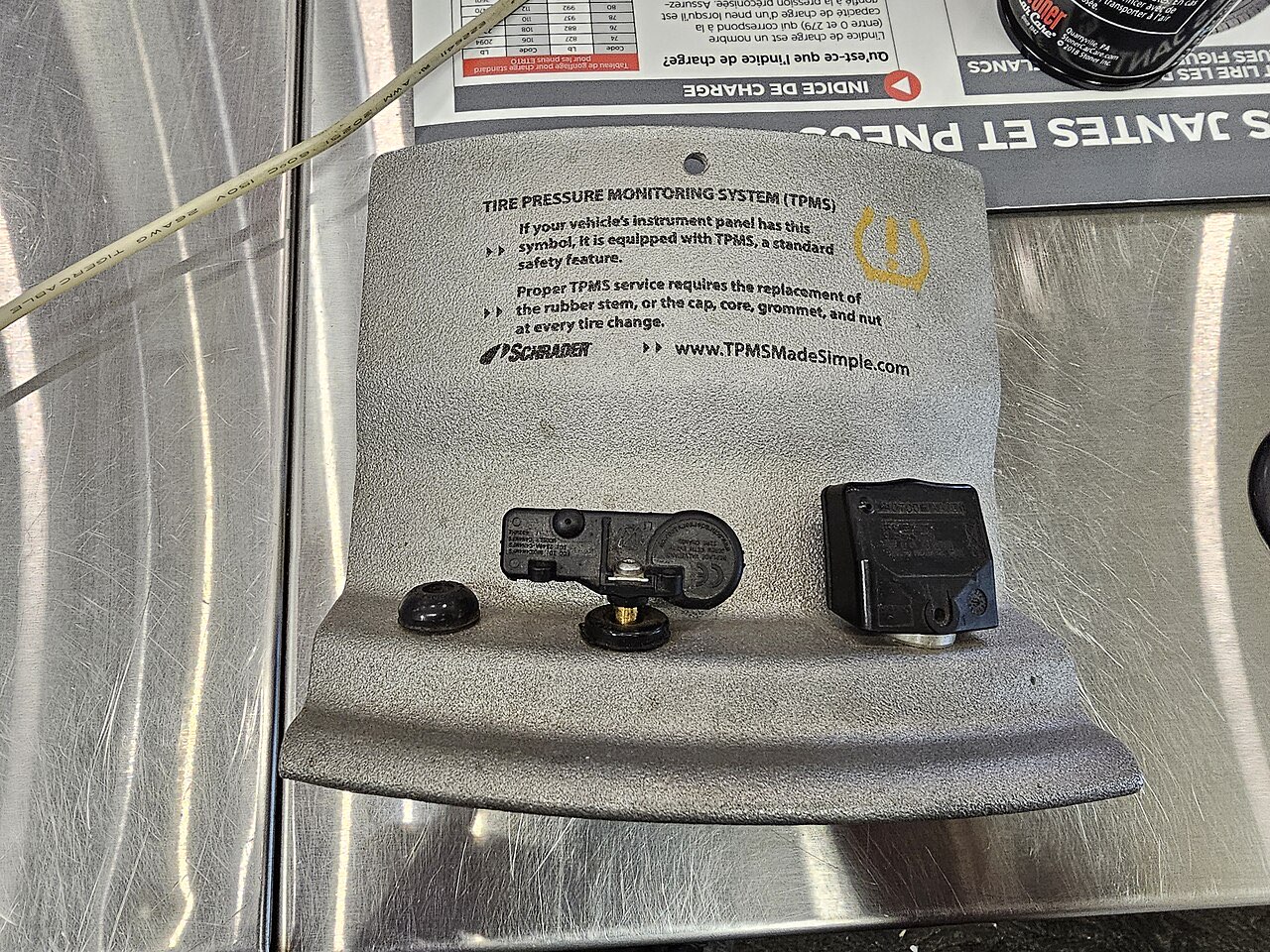
Aftermarket options: cap sensors screw onto the valve stem, take ten minutes to install, and report to a dash display or a phone; they add a few grams and work best on metal stems. Internal sensors mount inside the wheel like factory units and need a tire shop. Either way, buy enough sensors for every tire, set the low alarm at about 10 percent under your cold target, and set a high-temperature alarm around 160°F. A trailer tire that disintegrates at 65 mph takes fenders, floor, plumbing and wiring with it; the monitor is cheaper than one incident.
Tire gear
As an Amazon Associate we earn from qualifying purchases.
- AstroAI heavy-duty digital tire gauge (0-230 psi): Reads up to 230 psi, enough for high-pressure ST and LT tires; check cold.
 $23.99Price as of November 16, 2026, 10:00 AM ET. Prices and availability are accurate as of the date/time indicated and are subject to change. Any price and availability information displayed on Amazon.com at the time of purchase will apply to the purchase of this product.
- Tymate TM7 RV tire pressure monitoring system: An aftermarket TPMS for a towable or older rig.
 $39.99Price as of November 16, 2026, 10:00 AM ET. Prices and availability are accurate as of the date/time indicated and are subject to change. Any price and availability information displayed on Amazon.com at the time of purchase will apply to the purchase of this product.
ST vs LT tires on a towable
ST stands for Special Trailer. These tires are built for trailer axle positions only: stiffer sidewalls to resist sway, heavier cord, and no requirement to steer or drive. NHTSA’s 2016 rule (81 FR 78689) confirmed that ST tires are permitted on new trailers of 10,000 lb GVWR or less and exempted trailers from a rim-retention test that applies to light vehicles. Historically ST tires were built to a 65 mph standard and carried no speed symbol; a Goodyear bulletin, widely reproduced, said that at 66 to 75 mph the cold pressure should be raised 10 psi above the table value for the load, without any gain in capacity. Newer ST designs carry explicit speed symbols: Goodyear’s Endurance line is rated N, 87 mph, across all sizes in its table; Carlisle’s Radial Trail HD is rated M, 81 mph. If your trailer’s tires have no speed letter, treat 65 mph as the limit, and treat the limit as the design speed, not a target.
LT stands for Light Truck. LT tires carry higher speed ratings, more robust casings in the same size, and the full sidewall load rating when used on a trailer. Many fifth-wheel owners move to LT tires (or to 17.5-inch commercial tires on heavy fifth wheels) after a blowout. The rules for doing it: the LT tire’s load at its maximum pressure must meet or exceed the axle rating divided by two, the wheel must be rated for that pressure, and the tire must fit the wheel well with clearance for the sidewall at full load. Going down in load capacity, or putting an 80 psi tire on a 65 psi wheel, creates the problem you were trying to solve.
Passenger (P-metric) tires do not belong on a trailer at all; their load rating must be derated by about 10 percent on a trailer and their sidewalls are too soft.
When to replace, decided
Replace the set when any of these is true:
- The DOT date is six years old or more on a trailer, or past the chassis maker’s interval (not beyond ten years) on a motorhome.
- Sidewall cracking you can catch a fingernail in, any bulge, any exposed cord.
- Shoulder wear from underinflation or a history of running low (the carcass has been heat-cycled).
- One tire has failed and the others are the same age; a blowout at year five is a message about the other three.
- You cannot find a date code at all.
Replace in sets per axle at minimum, and for trailers, all four. Have the shop confirm the load range matches or exceeds the original (it is on the trailer’s tire placard), ask for the newest date codes in stock (anything older than a year on the rack is worth a question), and have them torque the lugs and recheck after 50 miles. Keep the old spare only if it is newer than the new tires’ replacement date, which it will not be.
The weight part of this guide is where the numbers start; the towing capacity vs payload guide explains the axle ratings those tires have to carry, and the tongue weight guide covers why a nose-light trailer sways even on perfect tires. Regulation text, Michelin’s bulletin and Goodyear’s table were read on October 28, 2026; confirm current guidance on the tire maker’s site and treat the placard on your own rig as the minimum.
Frequently asked questions
How do I tell how old an RV tire is?
Find the DOT code on the sidewall. Under federal rule 49 CFR 574.5 the last group is four digits: the first two are the week of manufacture and the last two the year, so 2324 is the 23rd week of 2024. The full code is only required on one sidewall, so check the inside of the wheel if the outside shows a partial code. Michelin's own example is 0316 for the third week of 2016.
How many years do RV tires last?
The two largest makers give different ceilings. Goodyear recommends replacing any tire in service six years or more, spare included, regardless of tread. Michelin's RV bulletin says replace after 10 years at the latest and have tires inspected by a specialist at least annually from year five. Trailer (ST) tires on travel trailers and fifth wheels tend to age out first because they sit loaded, in sun, for months; most owners replace them at five to six years.
What pressure should I run in my RV tires?
Motorhomes: weigh each axle, look up the heavier axle end's load in the tire maker's load/inflation table, and run that pressure on both sides, usually plus a small margin; the chassis placard is the floor. Travel trailers and fifth wheels on ST tires: most owners and makers run the maximum cold pressure molded on the sidewall, because trailer tires are usually loaded close to their rating and sway resistance improves with full pressure.
Does my trailer need TPMS?
Not by law. FMVSS 138 requires TPMS on cars, SUVs and trucks of 10,000 lb GVWR or less, and excludes vehicles with dual rear wheels, so a trailer or a dually-chassis motorhome has none from the factory. An aftermarket system with cap sensors on each trailer tire and a dash display is the single most useful tire accessory a towable owner can buy, because you cannot feel a trailer blowout from the driver's seat until the damage is done.
Can I put LT truck tires on my travel trailer instead of ST tires?
Often yes, if the LT tire's load rating at its pressure meets or exceeds the trailer's axle rating and the wheel is rated for the pressure. ST tires are built for trailer axles only, with stiffer sidewalls and a default 65 mph design speed unless a speed symbol says otherwise; LT tires carry higher speed ratings. The trailer maker's label and the tire maker's fitment guidance decide; never go down in load capacity.
Why does the TPMS warn on cold mornings and clear by noon?
Pressure falls roughly 1 psi for every 10°F drop in air temperature, and a factory TPMS triggers at 25 percent below placard. A tire set to the placard on a warm afternoon can be under the threshold at dawn. Set pressure cold, before driving and before the sun hits the tires, and add a few psi in the fall.
Keep planning
- How to Use an RV Dump Station Step by Step
How to use an RV dump station: black-then-gray order, hose setup, rinsing, chemicals, where to find free stations, typical fees and what never goes down the drain.
Updated Nov 2026 - RV Sewer Hose Setup: Length, Supports and Fittings
RV sewer hose setup explained: what length to carry, the clear elbow and 4-in-1 adapter, hose supports for a steady downhill run, valve habits and clean storage.
Updated Nov 2026 - RV Gear and Upgrades: Measure Before You Order
Fit guide for RV steps, bunk ladders, windows, shades, hose tubes, tote carriers and vents. Sizes come from the Amazon listings, including where a listing disagrees.
Updated Nov 2026