Tongue Weight Explained With Worked Examples
In this guide
- The rule and who says it
- What the spec sheets actually show
- Worked example 1: the family bunkhouse
- Worked example 2: the rear-living couple’s trailer
- Why the truck cares: tongue weight is payload
- Three ways to measure, cheapest to best
- What a weight-distribution hitch changes
- Sway, briefly
- Mistakes to avoid
- The short version
Tongue weight is the downward force a travel trailer’s coupler puts on the hitch ball, and it should be 10 to 15 percent of the trailer’s loaded weight. Too little and the trailer sways; too much and the truck’s rear axle and payload are overloaded. The brochure figure is a guess about an empty trailer; the number that keeps you safe is the one you measure with the trailer packed for a trip.
This guide explains where the 10 to 15 percent rule comes from, works the math on real trailers using manufacturer spec sheets, shows three ways to measure tongue weight from cheapest to most accurate, and explains what a weight-distribution hitch changes and what it does not. All figures are from manufacturer and hitch-maker pages read in October 2026.
The rule and who says it
Equal-i-zer, which has built weight-distribution hitches for decades, states in its FAQ that “most trailer’s tongue weights end up being between 10% and 15% of the overall trailer weight.” Retailer etrailer’s tongue-weight page says the same: typically 10 to 15 percent of total trailer weight. Older GM owner’s manuals use identical language about “10 percent to 15 percent of the total loaded trailer weight.” It is not a federal regulation; it is the consensus of the companies that design the hitches and the trucks, and the physics behind it is simple.
A trailer is a long mass on a pivot (the ball). If the mass sits ahead of the axles, the trailer wants to follow the truck and any wobble damps itself out. If the mass sits at or behind the axles, a disturbance pushes the tongue sideways, the trailer’s inertia carries it further, and the oscillation grows. The percentage is a proxy for where the mass sits. Ten percent is the floor where most trailers remain stable; fifteen percent is the ceiling where most trucks and receivers run out of capacity.
The percentage applies to loaded weight, not dry weight. This is the single most common mistake. A trailer’s dry hitch weight on a spec sheet was measured with empty tanks, no batteries in some cases, no propane in others, and nothing in the front pass-through. Load it and both numbers move.
What the spec sheets actually show
Three current trailers, with the manufacturer’s own figures:
| Trailer | Length | UVW (dry) | Dry hitch weight | Dry percentage | GVWR |
|---|---|---|---|---|---|
| Jayco Jay Flight SLX 260BH (2026) | 29’5” | 4,745 lb | 540 lb | 11.4% | 6,500 lb |
| Grand Design Imagine 2500RL | 29’7” | 6,569 lb | 678 lb | 10.3% | not on spec sheet |
| Grand Design Imagine 2970RL | 33’11” | 7,880 lb | 809 lb | 10.3% | not on spec sheet |
Sources: Jayco, Grand Design spec sheets for the 2500RL and 2970RL, both revised December 2024 and both carrying the note that weights “are based on the average weight of the standard build.”
Notice that the dry percentages cluster at the bottom of the safe range. That is deliberate: a low brochure hitch weight sells trailers to half-ton owners. It also means there is no margin. Load the Jayco to 6,000 lb with the fresh tank (52 gallons, about 430 lb) sitting ahead of the axles and the front compartment full, and tongue weight commonly lands between 700 and 800 lb, 12 to 13 percent. Load the same trailer with a heavy generator and bikes on the rear bumper and the percentage can fall below 10 while the total weight went up. Same trailer, opposite handling.
Worked example 1: the family bunkhouse
Jay Flight 260BH loaded for a week: 4,745 lb UVW plus 60 lb propane, 60 lb battery, 430 lb fresh water, 400 lb food, bedding, clothes and kitchen, 150 lb outdoor gear in the pass-through. Total about 5,850 lb.
- Minimum acceptable tongue weight: 585 lb (10%)
- Target: 700 to 760 lb (12 to 13%)
- Maximum before truck problems multiply: 878 lb (15%)
If a tongue scale reads 560 lb, the trailer is under 10 percent and needs weight moved forward: water tank forward of the axles filled, heavy items in the front pass-through, nothing on the rear bumper. If it reads 900 lb, move the generator or tools back toward the axles. Either adjustment is a matter of moving 100 to 200 lb a few feet, which changes tongue weight far more than most people expect because of the lever arm.
Worked example 2: the rear-living couple’s trailer
Imagine 2970RL loaded: 7,880 lb UVW plus propane, two batteries, half a fresh tank, a well-stocked residential-style kitchen and outdoor furniture. A realistic travel weight is 8,900 to 9,200 lb.
- 10%: 890 to 920 lb
- 13%: 1,160 to 1,200 lb
- 15%: 1,335 to 1,380 lb
Even at the bottom of the range this trailer puts 900 lb on the ball, and at a comfortable 12 to 13 percent it is over 1,100 lb. That figure is payload the truck has to carry before passengers; the towing capacity vs payload guide walks through why that pushes this trailer out of half-ton territory regardless of the tow rating, and can a half-ton tow a 30 ft travel trailer runs the same math for the shorter floorplans.
Why the truck cares: tongue weight is payload
Ford’s towing dictionary defines payload as cargo, passengers and accessories “plus the Tongue Weight if you are towing.” The tongue weight sits almost entirely on the truck’s rear axle, so three truck limits respond to it at once: payload (on the door-jamb Tire and Loading label), GVWR, and rear GAWR. A receiver hitch also carries its own tongue-weight rating, stamped on the receiver, usually with one figure for weight-carrying and a higher figure for weight-distributing use.
Equal-i-zer adds a point many owners miss: anything loaded behind the truck’s rear axle, a generator in the bed, a hitch-mounted cargo carrier, a full toolbox, adds to the lever on the rear axle exactly as tongue weight does, so the hitch should be sized for tongue weight plus that cargo.
Three ways to measure, cheapest to best
1. Bathroom scale and a lever (lighter trailers)
For a coupler that would crush a household scale, etrailer’s method uses leverage:
- Lay two lengths of pipe on a level surface, one on a brick, one on the bathroom scale. The brick must be the same thickness as the scale.
- Lay a stout beam (a 4x4 or doubled 2x6) across the pipes.
- Lower the coupler onto the beam exactly 1 ft from the brick-side pipe, with the trailer level at normal towing height.
- Multiply the scale reading by the total distance in feet between the two pipes. Pipes 3 ft apart: multiply by 3. Pipes 4 ft apart: multiply by 4.
Weigh Safe’s guide describes the same setup with a 4 ft board and a multiply-by-four factor. Accuracy depends on your measurements and the scale; expect plus or minus 10 percent. Useful for small trailers, marginal for anything over about 800 lb of tongue weight.
2. A dedicated tongue-weight scale
Sherline’s hydraulic tongue scale comes in 1,000, 2,000 and 5,000 lb versions, the largest aimed at fifth-wheel pins. Set it on solid blocks under the coupler at towing height, lower the tongue onto it until the jack is clear of the ground, and read the gauge. Hitch-ball mounts with a built-in gauge (Weigh Safe states plus or minus 50 lb accuracy for its design) read tongue weight every time you hook up, which is the easiest way to catch a load that shifted between trips. For most travel-trailer owners this is the right tool: repeatable, usable in the driveway, and accurate enough to tune the load.
3. The CAT scale subtraction method (most accurate)
A certified truck-stop scale gives tongue weight by subtraction, and gives you every axle weight at the same time:
- Drive on hitched and loaded with all four truck wheels on the platforms and the trailer wheels off the scale. Record the truck’s weight (A).
- Pull into the lot, unhook, crank the coupler clear of the ball so the truck carries nothing, drive back on and weigh the truck alone (B). Use the reweigh.
- Tongue weight = A − B.
CAT Scale’s US pricing as of October 2026 is $15.25 for the first weigh and $5.25 for a reweigh within 24 hours at the same scale (weighmytruck.com), so the whole exercise costs about $20. Step-by-step platform positioning and how to read the ticket are in how to weigh your RV at a CAT scale. For a full picture of side-to-side loading, which no truck-stop scale can give, the RV Safety and Education Foundation’s wheel-position weighing at rallies measures each tire individually; RVSEF notes a rig can be within GVWR and GAWR and still overload a single tire.
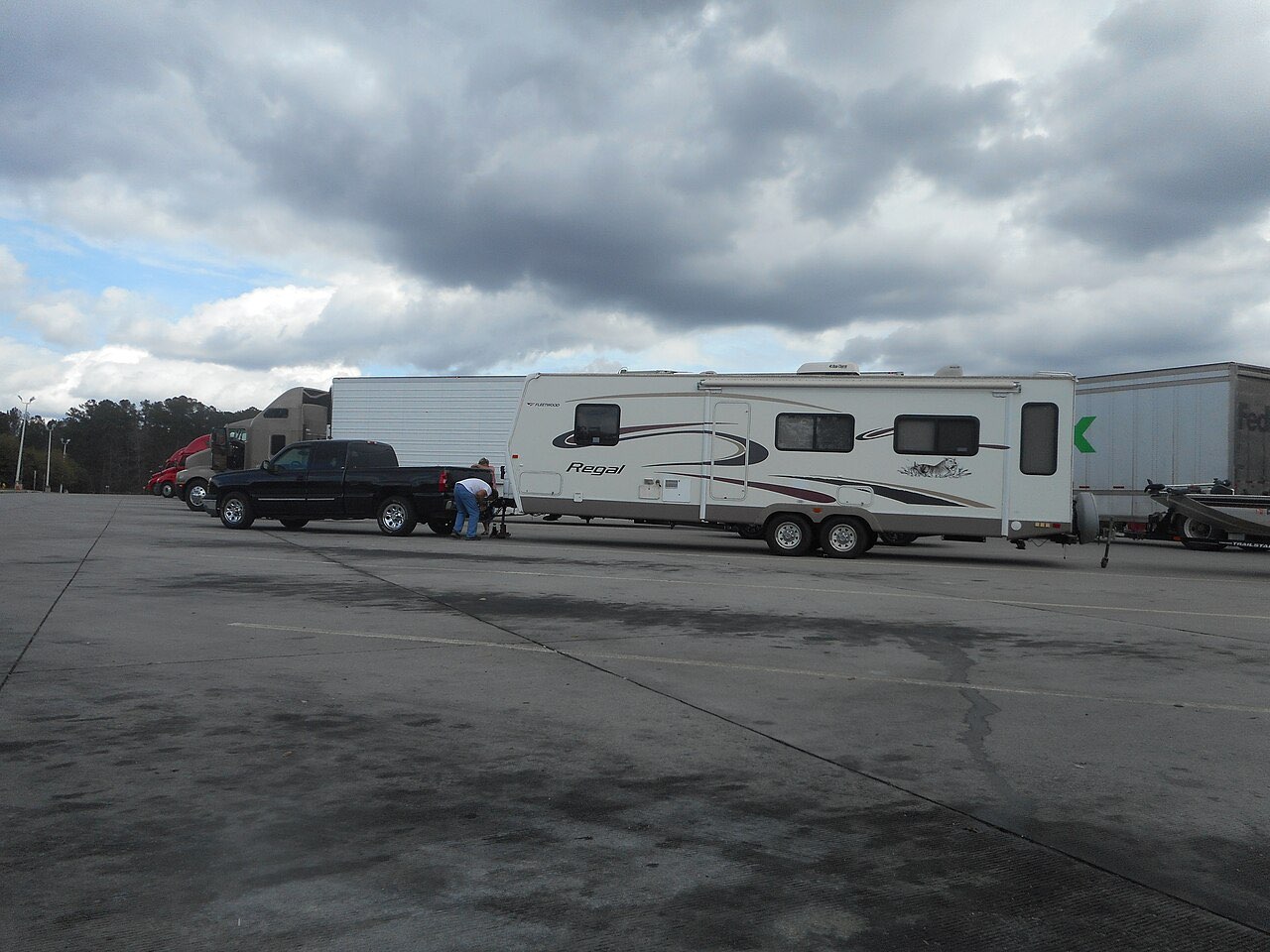
What a weight-distribution hitch changes
A weight-distribution hitch uses spring bars tensioned between the hitch head and brackets on the trailer frame. The tension lifts the rear of the truck and the front of the trailer, which pushes load forward onto the truck’s front axle and back onto the trailer’s axles. Equal-i-zer describes sway as what happens “when there is not enough weight transferred back up to the front axle of the tow vehicle,” and the hitch’s job is to put it back.
Three things it does:
- Restores front-axle weight, so steering and braking work as designed.
- Levels the combination, so headlights and trailer brakes behave.
- In integrated designs, adds friction that resists sway.
Three things it does not do:
- It does not reduce tongue weight. The truck still carries it; the sticker still counts it.
- It does not fix a trailer loaded below 10 percent. Sway control masks the symptom until the day it cannot.
- It does not add payload. The hitch itself, often 80 to 100 lb, is subtracted from it.
Set it up to the manufacturer’s procedure, which usually means measuring front fender height unhitched, hitched without bars, and hitched with bars, and adjusting until the front axle returns to roughly its unhitched height. The manual for your hitch gives the exact targets; follow it, not a forum.
Sway, briefly
Sway has three usual causes: tongue weight under 10 percent, speed, and crosswind or passing-truck bow waves. The first is the one you control at the campsite. If sway starts, do not brake the truck hard and do not steer against it; ease off the throttle, keep the wheel straight, and apply the trailer brakes alone with the brake controller’s manual lever. Then pull over and find out why. Nine times out of ten the answer is a rear-loaded trailer.
Mistakes to avoid
- Trusting dry hitch weight from the brochure.
- Measuring with empty tanks and then traveling full. Water is 8.3 lb per gallon and tank location decides which direction tongue weight moves.
- Hanging generators, bikes and coolers on the rear bumper.
- Loading the front pass-through with heavy tools “because there is room” on a trailer already at 15 percent.
- Choosing a weight-distribution hitch by trailer weight instead of loaded tongue weight plus bed cargo; Equal-i-zer’s guidance is to size for the combined figure.
- Not re-measuring after changing how you pack. Tongue weight is a property of the load, not the trailer.
The short version
Measure tongue weight with the trailer packed the way you travel, aim for 12 to 13 percent of loaded weight, never go under 10, and remember that every pound on the ball is a pound of truck payload. A $20 CAT scale session or a tongue scale in the driveway answers the question for good. Figures above were read from equalizerhitch.com, etrailer.com, weigh-safe.com, jayco.com, granddesignrv.com and weighmytruck.com on October 28, 2026; your trailer’s label and your truck’s door-jamb sticker override any general number here, and the hitch manual overrides this guide on setup.
Frequently asked questions
What should my travel trailer's tongue weight be?
Between 10 and 15 percent of the trailer's loaded weight, measured, not estimated from the brochure. Hitch makers such as Equal-i-zer and retailers such as etrailer both state this range, and older vehicle owner's manuals use the same 10 to 15 percent language. For a trailer that weighs 7,000 lb ready to travel, that is 700 to 1,050 lb on the ball. Many experienced owners aim for 12 to 13 percent as a margin against sway.
What happens if tongue weight is too low?
The trailer becomes prone to sway. With too little weight on the coupler, the trailer's center of mass sits near or behind its axles, and a gust, a passing truck or a lane change can start an oscillation that grows instead of damping out. Too little tongue weight is the most common cause of trailer sway, more common than speed or wind alone.
What happens if tongue weight is too high?
The truck's rear axle and payload get overloaded, the front axle unloads, steering gets light and headlights point at the sky. Above 15 percent you are usually over the hitch receiver's tongue rating as well; a Class IV receiver on a half-ton is often rated for 500 lb without weight distribution and more with it, and that figure is printed on the receiver.
Can I measure tongue weight with a bathroom scale?
Yes, for lighter trailers, using a lever. Rest a beam on two pipes, one on a brick and one on the scale, place the coupler one foot from the brick-side pipe, and multiply the scale reading by the total distance in feet between the two pipes. With pipes three feet apart, multiply by three. The brick should be the same height as the scale and the trailer must be level at towing height. A dedicated tongue scale is more accurate and costs less than a tank of fuel.
Does a weight-distribution hitch reduce tongue weight?
No. It moves part of the load forward onto the truck's front axle and back onto the trailer's axles so the combination sits level, but the tongue weight the truck carries is unchanged and still counts against payload and GVWR. Equal-i-zer's own FAQ describes the purpose as getting weight transferred back to the front axle, not removing it.
How do I get tongue weight from a CAT scale ticket?
Weigh the loaded truck hitched to the trailer with only the truck's axles on the platforms, then unhook, raise the coupler clear of the ball and weigh the truck alone. Subtract the second total from the first. Two weighs at US CAT Scale pricing cost $15.25 plus a $5.25 reweigh as of October 2026, provided the reweigh is within 24 hours at the same scale.
Keep planning
- Can a Half-Ton Truck Tow a 30 ft Travel Trailer?
Can a half-ton truck tow a 30 ft travel trailer? Sometimes. The payload math with real 2026 trailer specs and F-150 figures, plus how to check your own truck.
Updated Oct 2026 - How to Weigh Your RV at a CAT Scale
How to weigh your RV at a CAT scale: the 2026 price, the Weigh My Truck app, where each axle goes, how to read the ticket, and tongue weight from a reweigh.
Updated Oct 2026 - Towing Capacity vs Payload: What Actually Limits Your Truck
Towing capacity vs payload explained: official definitions, a worked half-ton example, and why the door-jamb payload sticker runs out long before the tow rating.
Updated Oct 2026