How to Weigh Your RV at a CAT Scale
In this guide
Weighing your RV at a CAT scale takes ten minutes, costs $15.25 in the US as of October 2026, and is the only way to know whether your truck, trailer or motorhome is inside its ratings. You drive the loaded rig onto three platforms, get a ticket with the weight on each, and compare those numbers to the labels on your door jamb and trailer. Add a $5.25 reweigh unhitched and you also get tongue weight or pin weight.
This guide covers the current price and the app, exactly where to put each axle, how to read the ticket, the reweigh trick for tongue weight, what the scale cannot tell you, and what to do when a number is over. Everything about the scales comes from CAT Scale’s own how-to-weigh page, its FAQ and the Weigh My Truck help page, read on October 28, 2026.
Before you go: what to bring and how to load
Weigh the rig the way you travel, not the way it sits in storage. That means:
- Fresh water at the level you normally tow with (full if you boondock, a third if you usually fill at the campground).
- Propane full, batteries installed, generator aboard.
- Every passenger who will be in the truck, plus the dog.
- Food, clothes, bikes, chairs, tools, firewood. If it rides with you, it rides onto the scale.
- The truck’s fuel tank at least three-quarters full.
Bring a photo of three labels so you can compare in the parking lot: the truck’s Safety Certification Label (GVWR and front and rear GAWR), the truck’s Tire and Loading Information label (payload), and the trailer’s weight label (GVWR, GAWR and cargo carrying capacity). Ford’s towing dictionary notes the payload figure is on the Tire and Loading label on the driver’s door jamb; federal rule 49 CFR 571.110 puts that label on the driver’s B-pillar and requires it to state the maximum combined weight of occupants and cargo. If you need a refresher on what each rating means, start with towing capacity vs payload.
The price and the app
CAT Scale’s posted pricing on the Weigh My Truck help page is “$15.25 for a first weigh and $5.25 for a reweigh” at US locations, C$26.00 and C$8.50 in Canada. A reweigh “is the same truck and trailer within 24 hours at the same CAT Scale location.” The FAQ adds that after a full-price weigh and two reweighs the on-duty manager may stop further reweighs until a commercial truck is legal; for an RVer doing one hitched and one unhitched pass, this never comes up. Older newsletters quote $14.75 and $5.00, so expect the price to move; the app shows the current figure before you confirm.
The Weigh My Truck app (iOS and Android, free, no extra CAT charge) removes the intercom and the walk inside:
- Create an account and add your vehicle. Pick any license plate or name as the “truck number”; it just labels the ticket.
- Drive onto the scale. The app asks you to confirm the location, or you type the scale number from the sign by the intercom.
- Confirm the vehicle shown on your screen.
- Wait while the weighmaster checks that your axles are positioned correctly. The guaranteed weight then appears on your phone.
- A PDF ticket is emailed to you. A paper copy is available inside if you want one.
Payment is by card or PayPal in the app, or at the fuel desk if you use the intercom. Either way the ticket is the same legal document, and CAT notes tickets cannot be altered after printing.
Where each axle goes
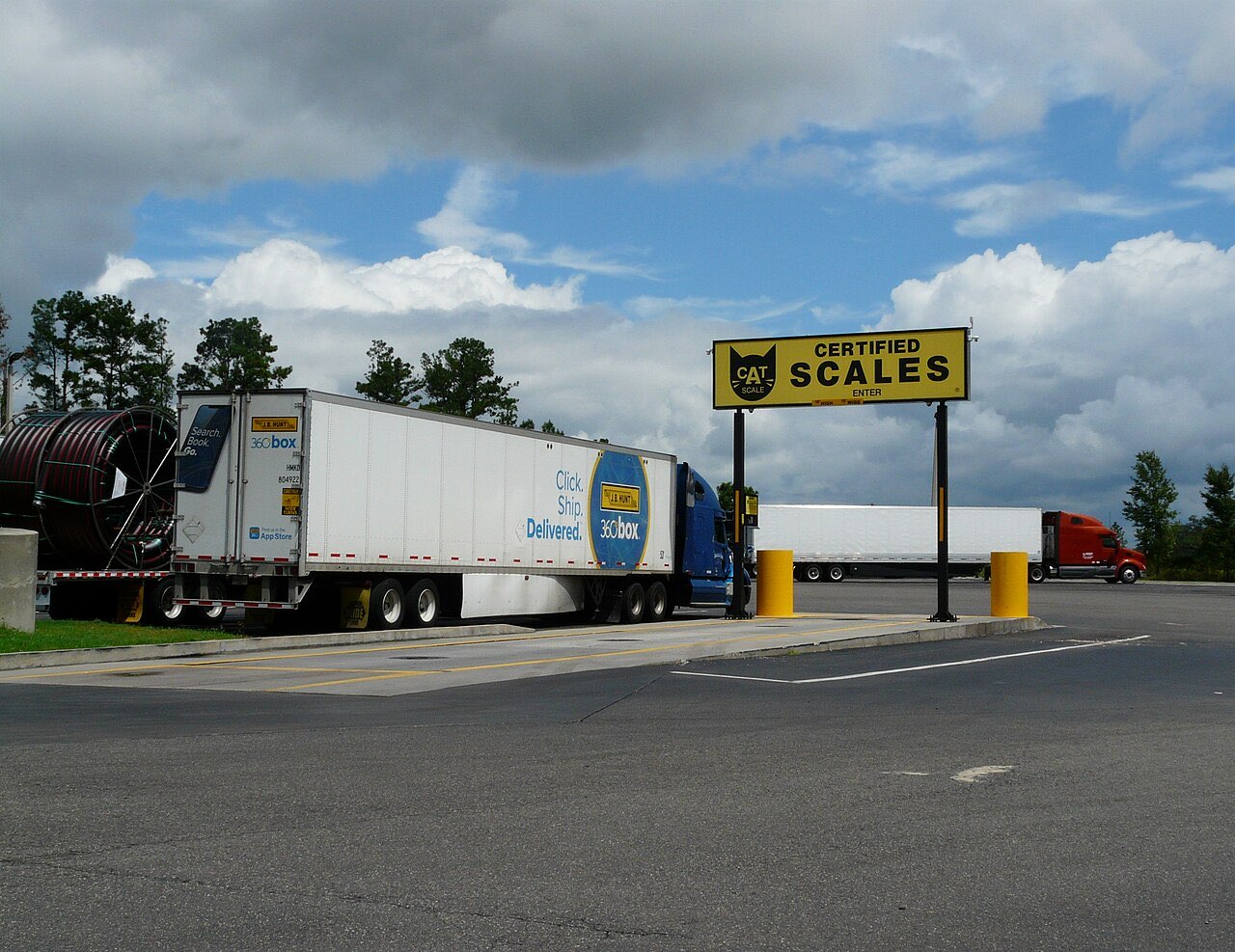
A CAT scale is three platforms in a row, numbered 1, 2, 3 from the front, built for a tractor-trailer’s steer axle, drive axles and trailer axles. RVs map onto them like this, per CAT’s own diagram:
| Rig | Platform 1 | Platform 2 | Platform 3 |
|---|---|---|---|
| Pickup + travel trailer | Truck front axle | Truck rear axle | Trailer axles |
| Pickup + fifth wheel | Truck front axle | Truck rear axle | Trailer axles |
| Motorhome | Front axle | Rear axle | Empty |
| Motorhome + towed car | Front axle | Rear axle | Towed car |
| Truck camper | Front axle | Rear axle | Empty (or trailer) |
Rules that trip people up:
- The whole rig must be on the scale. If your trailer’s rear axle hangs off the back of platform 3, you are too long for a normal weigh; pull forward and call the help desk (1-877-228-7225, ext. 6) through the intercom and the weighmaster will talk you through a two-position weigh.
- Stay in the lane markings. The platforms are separated by small gaps; an axle straddling a gap gives a bad reading, which is what the weighmaster is checking for before releasing your weight.
- Tag-axle motorhomes should call the help desk; CAT asks for it.
- Stay in the vehicle with the engine running and your foot off the brake. Passengers stay seated; they are part of the weight.
Reading the ticket
The ticket lists a weight for each platform plus a gross. For a pickup and travel trailer the lines are labeled Steer, Drive and Trailer; translate them like this:
| Ticket line | What it is | Compare to |
|---|---|---|
| Steer | Truck front axle weight | Truck front GAWR |
| Drive | Truck rear axle weight, including tongue weight | Truck rear GAWR |
| Steer + Drive | Truck gross vehicle weight | Truck GVWR |
| Trailer | Weight on the trailer’s axles, not the trailer’s total weight | Trailer GAWR (sum of axles) |
| Gross | Everything | Truck GCWR |
The one line everyone misreads is Trailer. That number is what the trailer’s axles carry; the tongue weight is sitting on the truck’s drive axle. The trailer’s true weight is Trailer plus tongue weight, and that is the figure to compare with the trailer’s GVWR. Which is why you do the reweigh.
The reweigh: tongue weight and payload in one more pass
- Write down the hitched numbers: Steer, Drive, Trailer, Gross.
- Pull into the lot. Unhook the trailer completely, crank the coupler or pin up until the truck carries none of it, and leave the trailer in a legal spot with the wheels chocked.
- Drive the truck back on alone, front axle on 1, rear axle on 2, and take the $5.25 reweigh. Everyone stays in the truck.
- Do the arithmetic:
- Tongue weight = hitched truck gross (Steer + Drive) − unhitched truck gross.
- Trailer total weight = hitched Trailer reading + tongue weight. Compare to trailer GVWR.
- Tongue weight percentage = tongue weight ÷ trailer total weight. Target 10 to 15 percent for a travel trailer; see the tongue weight guide for what to do if it is outside that band.
- Truck payload used = hitched truck gross − truck curb weight. If you do not know curb weight, a third pass with the truck empty of people and gear gives it, but the simpler check is hitched truck gross against GVWR.
- Weight-distribution check: compare the unhitched Steer reading to the hitched Steer reading. With spring bars properly tensioned they should be close; a hitched front axle that is several hundred pounds lighter than unhitched means the hitch is under-adjusted.
A worked ticket
Half-ton crew cab, 29-foot travel trailer, family of four aboard, tanks as traveled.
| Pass | Steer | Drive | Trailer | Gross |
|---|---|---|---|---|
| Hitched | 3,240 | 3,820 | 5,460 | 12,520 |
| Unhitched (reweigh) | 3,380 | 2,960 | — | 6,340 |
- Tongue weight: 7,060 − 6,340 = 720 lb
- Trailer total: 5,460 + 720 = 6,180 lb (against a 6,500 lb trailer GVWR: fine)
- Tongue percentage: 720 ÷ 6,180 = 11.7% (inside 10 to 15: fine)
- Hitched truck gross: 7,060 lb against a 7,050 lb GVWR: 10 lb over
- Hitched Steer 3,240 vs unhitched 3,380: 140 lb unloaded from the front; acceptable, but the hitch could take another link
- Drive 3,820 against a 4,100 lb rear GAWR: fine
The trailer passes every test. The truck is at GVWR with a light trailer, which is the normal result for a half-ton and the reason the half-ton and 30-foot trailer question has such a long answer. The fix here is 150 lb out of the truck bed and into the trailer, ahead of the axles, which raises tongue weight slightly and lowers the truck by roughly 150 lb net.
What a CAT scale cannot tell you
CAT is explicit: it “cannot weigh individual corners or provide individual wheel weights, and does not allow that weighing.” An axle can be under its GAWR while one tire on it is over its own load rating, because slide-outs, water tanks, refrigerators and batteries sit on one side. The RV Safety and Education Foundation’s wheel-position weighing, done with portable 20,000 lb pads at rallies and events, measures each wheel; RVSEF states it is “possible to be within your Gross Vehicle Weight Rating (GVWR) and your Gross Axle Weight Ratings (GAWR), and still overload a tire at an individual wheel position,” and quotes Michelin and Goodyear recommending each axle end be weighed separately. RVSEF suggests repeating it every three to four years or after major changes. Its current fee is not posted on the page; budget around the price of a tank of fuel and confirm when you book. Pair the wheel weights with the tire maker’s inflation table, which the RV tire age and pressure guide explains how to read.
A CAT scale also does not weigh anything under 2,000 lb, and it is not a weigh station. The roadside state scales with the “trucks must enter” signs are for commercial vehicles; most states do not require private RVs to pull in, and the officers there will not weigh your trailer as a favor. Use the truck stop.
When a number is over
| Over on | Usual cause | Usual fix |
|---|---|---|
| Truck GVWR or payload | Tongue weight plus people plus bed cargo | Move cargo from truck to trailer (forward of axles); carry less; a larger truck |
| Truck rear GAWR | Same, plus heavy bed loads behind the axle | Weight-distribution hitch properly tensioned; move bed cargo forward or into trailer |
| Trailer GVWR | Water, tools, “while we’re at it” packing | Travel with less water; unload storage bays; weigh what you removed |
| GCWR | Heavy everything | Less of everything, or a different combination |
| Tongue under 10% | Rear-loaded trailer | Move weight forward; fill forward tanks; nothing on the rear bumper |
Do not round in your favor. Ratings are maximums, tested on new components in good condition, and tires age, springs sag and brakes fade in heat.
Where to find a scale and when to go
CAT scales sit at major truck stops along interstates; the free CAT Scale Locator app and the Weigh My Truck app both show them. Go mid-morning or mid-afternoon on a weekday when the fuel islands are quiet; avoid the 6 to 8 am and evening rush when drivers are weighing before and after loads. If a truck is waiting behind you, finish your pass, pull forward, and do the reweigh after the line clears; the 24-hour window is generous. Weigh once a season and after any change in how you pack, and keep the tickets. They are the only record that your rig was inside its ratings on a given day, which matters more than most owners think if there is ever a crash investigation or an insurance question; the RV insurance guide covers how carriers treat overloaded vehicles.
Prices, platform rules and the guarantee above were read from catscale.com and weighmytruck.com on October 28, 2026. Confirm the current price in the app before you drive on, and treat your own door-jamb labels, not this page, as the ratings that apply to your vehicle.
Frequently asked questions
How much does it cost to weigh an RV at a CAT scale?
As of October 2026, CAT Scale's posted US price is $15.25 for a first weigh and $5.25 for a reweigh of the same vehicle at the same scale within 24 hours. Canadian locations are C$26.00 and C$8.50. A California Weighmaster Certificate, which RVers almost never need, is $30.50 and $10.50. Prices are shown in the Weigh My Truck app before you confirm, and the app itself is free.
Do I have to go inside the truck stop to weigh?
Not if you use the Weigh My Truck app. You drive onto the scale, the app confirms the location, you confirm your vehicle, the weighmaster checks your positioning remotely, and the guaranteed weight appears on your phone with a PDF ticket emailed to you. Without the app you press the intercom button, give a name or unit number, then park and walk in to pay and collect the paper ticket.
Where do the axles go on the three platforms?
For a pickup and travel trailer or fifth wheel, the truck's front axle on platform 1, the truck's rear axle on platform 2, and the trailer axles on platform 3. For a motorhome, front axle on 1, rear axle on 2, and platform 3 stays empty unless you are towing a car, which goes on 3. The whole combination must be on the scale.
Can a CAT scale weigh each wheel separately?
No. CAT Scale states it cannot weigh individual corners or provide individual wheel weights and does not allow it, to protect the vehicle and the scale. You get per-axle weights and a gross. For side-to-side weights you need wheel-position weighing with portable pads, which the RV Safety and Education Foundation offers at rallies.
Is there a minimum weight?
Yes. CAT Scale says its scales weigh vehicles between 2,000 lb and 200,000 lb, and if your vehicle or combination might be lighter than 2,000 lb you should call the help desk first. No RV combination is that light, but a small teardrop alone might be.
What if the scale says I am legal and I still get a fine?
CAT Scale guarantees its weights. If a state fine follows a CAT ticket that showed you legal, the company checks the scale; if it was wrong it reimburses the fine, and if it was right a representative appears in court as a witness. That guarantee is written for commercial trucks, but the accuracy it implies is why RVers use these scales rather than guessing.
Keep planning
- Can a Half-Ton Truck Tow a 30 ft Travel Trailer?
Can a half-ton truck tow a 30 ft travel trailer? Sometimes. The payload math with real 2026 trailer specs and F-150 figures, plus how to check your own truck.
Updated Oct 2026 - Towing Capacity vs Payload: What Actually Limits Your Truck
Towing capacity vs payload explained: official definitions, a worked half-ton example, and why the door-jamb payload sticker runs out long before the tow rating.
Updated Oct 2026 - Tongue Weight Explained With Worked Examples
Tongue weight explained: the 10 to 15 percent rule, three ways to measure it, worked examples from real spec sheets, and what a weight-distribution hitch changes.
Updated Oct 2026