Flat Towing a Car Behind a Motorhome: Dinghy Basics

In this guide
You can flat tow a car behind a motorhome only if the car’s maker says so in its owner’s manual or towing guide, and you then need a base plate, a rated tow bar, safety cables, towed-car lighting and, in most cases, a supplemental braking system. The manual’s procedure (transfer case in neutral, a special tow mode, an engine-run interval, a speed limit) is not optional; skipping it can destroy a transmission or transfer case. If your car is not on the maker’s list, a tow dolly or car trailer is the answer.
This guide covers how to check eligibility, the gear, braking laws and the daily hookup routine. Eligibility examples come from Ford’s 2023 RV and Trailer Towing Guide (Ford’s newer editions were not retrievable when we checked); legal examples are from state statutes read in October 2026. Your vehicle’s manual for its exact model year is the final word.
Step 1: Confirm the car is flat-towable
“Flat towing” (also called four-down or dinghy towing) means all four of the car’s wheels roll on the road. Many drivetrains are not designed for it: the wheels turn the transmission or transfer case while the engine is off and the lubrication pump is not running.
Ford’s support page tells owners to open the RV and Trailer Towing Guide for their model year and look up the Four-Wheel-Down Availability table, then follow the towing section of the owner’s manual. As an example of what such a table looks like, here is Ford’s 2023 version:
| Ford 2023 vehicle | Flat tow? | Ford’s conditions (footnotes) |
|---|---|---|
| Bronco (auto and manual) | Yes | Transfer case in neutral tow position |
| Ranger 4x4, F-150 4x4, F-150 Raptor, Super Duty 4x4 | Yes | Transfer case in neutral tow position |
| Expedition / Expedition MAX 4x4 | Yes | Requires 2-speed transfer case; neutral tow position |
| Escape Hybrid, Escape Plug-in Hybrid, Maverick Hybrid | Yes | Max 70 mph; “Neutral Tow” mode; run engine 1 minute at the start of each day and every 6 hours |
| Edge ST | Yes | Max 65 mph; run engine 5 minutes at the start of each day and every 6 hours; Manual Park Release |
| Escape (non-hybrid), Edge (non-ST), Explorer, Bronco Sport, Maverick (non-hybrid), Mustang, Mach-E, F-150 Lightning, 4x2 trucks, Transit | No | Use a dolly or trailer where Ford’s dolly table allows |
Read the table for what it shows: eligibility depends on trim and drivetrain, not just the nameplate. An Escape Hybrid is flat-towable in 2023; a gas Escape is not. A 4x4 Ranger is; a 4x2 Ranger is not. Ford also notes that some aftermarket kits claim to let automatics be flat towed and warns these “could void the warranty.”
Other makers publish the same thing in their owner’s manuals. A 2011 Jeep Wrangler owner’s manual, for example, lists flat towing for 4WD models with the transfer case in neutral, the automatic in park (or the manual in gear), towing forward only, and says wheel-lift and dolly towing are not allowed. Procedures change between model years, so read the manual for your exact year, and do not rely on a list compiled by anyone else, including this one.
Step 2: Check the motorhome’s limits
The motorhome has to be rated to pull the car:
- Hitch receiver rating on the motorhome’s receiver label.
- GCWR (gross combination weight rating) minus the motorhome’s actual loaded weight gives the most the car can weigh. On Ford’s F-53 Class A chassis, the 2023 guide lists GCWRs of 23,000, 26,000 and 30,000 lb and a 7,000 lb maximum trailer weight on the 16,000 lb GVWR chassis.
- The car’s real weight, with fuel and whatever you leave in it. Weigh it; the CAT scale guide explains how.
Our towing capacity vs payload guide explains GCWR in more detail; the same rules apply to a motorhome.
Step 3: The equipment

| Component | What it does | What to check |
|---|---|---|
| Base plate | Vehicle-specific brackets bolted to the car’s frame behind the bumper, with removable tabs for the tow bar | Must be made for your exact make, model and year |
| Tow bar | A-frame bar from the motorhome receiver to the base plate | Rated at or above the car’s weight; receiver size |
| Safety cables or chains | Backup connection if the bar or a pin fails | Crossed under the bar, slack enough to turn, not dragging |
| Lighting | Car’s lights show the motorhome’s brake and turn signals | Diode kit, separate bulbs or magnetic lights |
| Supplemental braking | Applies the car’s brakes when the motorhome brakes; breakaway function | Compatible with your car’s brake system |
Tow bar capacity. Blue Ox’s tow bar range, as listed in October 2026, runs from 6,500 to 15,000 lb: the Alpha is rated 8,500 lb (2-inch receiver), the Avail 10,000 lb and the Apollo 15,000 lb (2 or 2.5-inch receivers). Pick a bar rated for the car’s loaded weight, not its curb weight from a brochure.
Height. Tow bar makers specify how close to level the bar should run between the receiver and the base plate; use a drop or rise receiver to meet their guidance.
Safety chains. Ford’s guide says to always use them, cross them so a separated tongue cannot hit the ground, and leave only enough slack to turn without dragging.
Supplemental braking: law and reason
A 4,000 lb car pushing on the back of a motorhome adds stopping distance, and the motorhome’s brakes were sized for the motorhome. Ford’s towing guide says towed vehicles “should be equipped with a separate functional brake system.”
The law varies by state and is often written for “trailers,” so whether a towed car counts depends on the state’s definitions. Two examples, read from the statutes in October 2026:
- Wisconsin (347.35(3)) explicitly covers “other towed vehicle[s]”: 3,000 lb or more needs brakes adequate to stop and hold it, except that a towed motor vehicle may go without if it weighs no more than 40 percent of the towing vehicle and the towing vehicle’s brakes can stop the combination within the state’s performance standard.
- Arizona (28-952) requires a trailer or semitrailer of 3,000 lb or more to have brakes applied from the cab or automatically, with automatic application on breakaway.
Florida’s trailer rule uses a similar 3,000 lb and 40 percent structure. Other states use different weights or stopping-distance tests. Check the statute for your home state and every state on your route, and meet the strictest. Supplemental braking is cheap insurance even where it is not required.
Types you will see: portable “box” units that sit on the driver’s floor and press the pedal; permanently installed units that pull the pedal or tie into the brake system; and proportional versus on/off designs. Check compatibility with your car’s brake booster (vacuum or electric) and with any brake-pedal or airbag cautions in the car’s manual.
The hookup routine
Every towed vehicle has its own steps, but a typical sequence:
- Park straight and level, motorhome in park with the brake set.
- Connect the tow bar arms to the base plate tabs and pin them; insert the receiver pin and clip.
- Attach safety cables, crossed, and the breakaway cable for the braking system.
- Plug in the lighting and test brake, turn and tail lights with a helper.
- Set up the braking system per its manual and test it.
- Put the car in its tow mode exactly as the owner’s manual says: transfer case neutral, transmission position, “Neutral Tow” or similar mode, ignition position, steering unlocked.
- Release the car’s parking brake. Forgetting this is the classic mistake.
- Pull forward slowly and confirm the tow bar arms lock out straight.
- Re-check at every stop: pins, cables, lights, and any engine-run interval the manual requires (Ford’s hybrids: one minute at the start of each day and every six hours).

Driving with a car behind you
- Plan on not backing up. A flat-towed car’s front wheels steer freely, and backing more than a few feet can jackknife the tow bar or turn the wheels sideways; check your tow bar’s instructions, and unhook if you need to reverse. Plan fuel stops with pull-through exits.
- Leave more stopping distance and brake earlier on downgrades. Our mountain driving guide covers gear selection on long descents.
- Watch tire pressure on the car, which you cannot see. A TPMS that covers the towed vehicle helps; see our TPMS guide.
- Battery drain. Some cars draw power from their 12-volt battery in tow mode; the car’s manual and the braking system’s manual tell you whether to use a charge line.
Flat tow vs dolly vs trailer
| Flat tow | Tow dolly | Car trailer | |
|---|---|---|---|
| Vehicle eligibility | Maker must approve four-down | Usually front-wheel drive; check maker (Ford says its intelligent AWD/4WD vehicles cannot be dolly towed) | Almost any vehicle |
| Hookup time | Fastest once set up | Moderate | Slowest |
| Storage at camp | Nothing extra | Dolly needs a spot | Trailer needs a spot |
| Backing up | Not possible | Not practical | Possible but hard |
| Added weight | Bar and plate only | Dolly weight | Trailer weight counts against GCWR |
Mistakes to avoid
- Trusting a “flat-towable cars” list from a forum or magazine instead of your exact-year owner’s manual.
- Leaving the parking brake on, or the transfer case out of neutral.
- Skipping the engine-run interval your manual requires.
- Backing up while hooked beyond what the tow bar maker allows.
- No breakaway for the supplemental brake system.
For the motorhome itself, the RV travel day checklist covers the rest of the walk-around.
Gear that helps with this job
Pick one braking system that is compatible with your towed car’s brakes; these are examples, not the only options.
As an Amazon Associate we earn from qualifying purchases.
- Blue Ox Patriot BRK2022 flat tow brake: A portable, all-electric supplemental braking unit that sits on the car’s floor; it checks brake pressure during setup and is moved between cars.
 $1,388.37Price as of November 16, 2026, 10:00 AM ET. Prices and availability are accurate as of the date/time indicated and are subject to change. Any price and availability information displayed on Amazon.com at the time of purchase will apply to the purchase of this product.
- Roadmaster 8700 InvisiBrake: A permanently installed, hidden supplemental braking system for towed vehicles with vacuum-powered brakes, with a built-in battery maintainer.
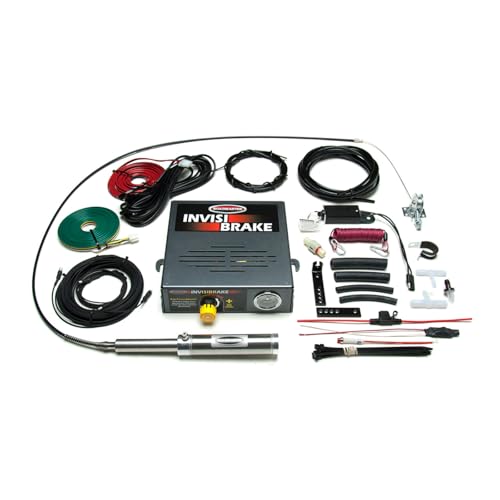 $1,380.00Price as of November 16, 2026, 10:00 AM ET. Prices and availability are accurate as of the date/time indicated and are subject to change. Any price and availability information displayed on Amazon.com at the time of purchase will apply to the purchase of this product.
- Tymate TM7 tire pressure monitoring system: Lets the driver watch tire pressures they cannot see, including on the towed car if sensors are fitted to it.
 $39.99Price as of November 16, 2026, 10:00 AM ET. Prices and availability are accurate as of the date/time indicated and are subject to change. Any price and availability information displayed on Amazon.com at the time of purchase will apply to the purchase of this product.
Listings change; confirm fit with your vehicle and the maker’s compatibility list before buying.
Eligibility examples above are from Ford’s 2023 RV and Trailer Towing Guide and a 2011 Jeep Wrangler owner’s manual; laws are from the Wisconsin and Arizona statutes as read in October 2026. Your car’s current owner’s manual and each state’s current law override anything here.
Frequently asked questions
How do I know if my car can be flat towed?
Only the vehicle maker can tell you. Look in the owner's manual for a section called recreational towing, towing behind a motorhome, or four-wheel-down towing, and follow it exactly. Ford publishes a Four-Wheel-Down Availability table in each year's RV and Trailer Towing Guide; its 2023 table lists vehicles such as the Bronco, Ranger 4x4, F-150 4x4 and Escape Hybrid as flat-towable with specific procedures, and many others as not. If the manual does not approve it, use a dolly or trailer instead.
Do I need a supplemental braking system for a towed car?
Often by law and always by good practice. Ford's towing guide says towed vehicles should have a separate functional brake system. Wisconsin's statute, for example, requires brakes on any towed vehicle of 3,000 lb or more unless it weighs no more than 40 percent of the towing vehicle and the motorhome can stop the combination within the required distance. Thresholds and wording differ by state, so check every state on your route.
What equipment do I need to flat tow?
Four pieces: a vehicle-specific base plate bolted to the car's frame, a tow bar rated for the car's weight, safety cables or chains, and a lighting connection so the car shows brake and turn signals. Add a supplemental braking system with a breakaway function. The motorhome's hitch receiver and GCWR must also cover the car.
Can you flat tow a car with an automatic transmission?
Only if the vehicle maker approves it. Some automatics can, using a specific neutral-tow procedure: Ford's 2023 table lists the Escape Hybrid and Maverick Hybrid with a Neutral Tow mode, a 70 mph limit, and an instruction to run the engine for one minute at the start of each day and every six hours. Most automatics without such a procedure cannot be flat towed without damaging the transmission. Ford warns that aftermarket kits that allow flat towing could void the warranty.
How fast can you go when flat towing?
Use the lowest of three limits: the towed vehicle's flat-tow speed limit in its manual (Ford lists 70 mph for its hybrids and 65 mph for the Edge ST in the 2023 guide), the tow bar maker's limit, and the posted limit for vehicles towing in each state. Many states set lower limits for combinations than for cars.
Keep planning
- Fifth Wheel Hitch Types: Rails, Puck, Slider, Gooseneck Adapter
Fifth wheel hitch types compared from the makers' specs: rail-mounted, OEM puck, sliders for short beds and gooseneck adapters, with real GTW and pin ratings.
Updated Oct 2026 - Can a Half-Ton Truck Tow a 30 ft Travel Trailer?
Can a half-ton truck tow a 30 ft travel trailer? Sometimes. The payload math with real 2026 trailer specs and F-150 figures, plus how to check your own truck.
Updated Oct 2026 - How to Weigh Your RV at a CAT Scale
How to weigh your RV at a CAT scale: the 2026 price, the Weigh My Truck app, where each axle goes, how to read the ticket, and tongue weight from a reweigh.
Updated Oct 2026