RV Storage Cost and Options: Outdoor, Covered, Indoor
In this guide
Storing an RV costs roughly $100 a month outdoors, $120 to $220 under a roof, and $180 to $310 indoors in the typical bands from Extra Space Storage’s 2026 price guide, with a national spread of $35 to $582 depending on the metro and the rig. Over a year that is $1,200 to $3,700, which for most owners is the second-largest line in the budget after the loan, and the one they forgot to put in the budget. Whether you can avoid it by parking at home depends on your city’s code and your HOA, and the common answer is 72 hours and then it has to move.
This guide gives the price ranges by storage type, RV type and city from an operator’s published guide and marketplace snapshots, what a facility will require from you, two real municipal ordinances as examples of what “just park it in the driveway” runs into, what to do with insurance while the RV sits, and the prep that keeps a stored RV from costing you a roof or a set of tires. Prices are as published in October 2026 and move with the season; get quotes.
What storage costs, by type
| Type | What you get | Extra Space “typical” band, 2026 | Full range across its markets |
|---|---|---|---|
| Outdoor, uncovered | A numbered space on gravel or asphalt behind a gate | $99 to $119 / month | $35 to $363 |
| Covered | A roof on posts; open sides | $121 to $216 / month | $45 to $385 |
| Indoor | Enclosed building or large unit; often 10x20 to 10x30 or bigger | $180 to $309 / month | $50 to $582 |
| Indoor, climate-controlled | Heated/cooled building | $25 to $50 more than indoor |
Source: Extra Space Storage’s RV storage price guide, dated 2026, read 28 October 2026. It is one operator’s data and skews toward self-storage sites in metro areas; a rural lot behind a farm gate can be half the outdoor figure, and a dedicated boat-and-RV facility in a coastal city can be double the indoor one.
The same guide breaks out averages by RV type, which mostly tracks length:
| RV type (length) | Avg. outdoor | Avg. covered | Space it fits |
|---|---|---|---|
| Class A motorhome (26 to 45 ft) | $106 | $138 | 10x30 |
| Class B van (17 to 23 ft) | $106 | $138 | 10x30 |
| Class C (20 to 23 ft) | $91 | $114 | 10x25 |
| Fifth wheel (22 to 40 ft) | $91 | $114 | 10x25 |
| Travel trailer (12 to 35 ft) | $90 | $206 | 10x20 |
| Pop-up (16 to 32 ft) | $69 | $151 | 10x15 |
Two things to notice. Covered pricing varies more than outdoor, because covered height is the constraint: a tall fifth wheel needs a 14-foot canopy that fewer facilities have. And some facilities, especially in expensive metros, price per foot of length instead of per space; secondary reports put that in the high single digits to mid-teens of dollars per foot per month outdoors, which for a 35-foot rig lands in the same $300-plus territory as the city averages below.
What it costs by city
Marketplace averages give a better feel for the spread than a national band. SpareFoot’s city pages, each dated on the page in 2026, listed average monthly RV storage at about $186 to $194 in Altamonte Springs, Florida; $276 in Spartanburg, South Carolina; $283 in Washington, DC; $355 in Stanton, California; $359 in Rancho Cucamonga, California; and $448 in Springfield, Virginia. Extra Space’s own city table ran from a $35 minimum in Albuquerque and $44 in Houston to $410 at the top of the Miami range and $396 in Scottsdale, with Chicago’s whole range only $61 to $108 and Sacramento’s $67 to $139. Those ranges mix all storage types, so the low end is an uncovered gravel space and the high end an enclosed bay.
The pattern: Sunbelt metros with lots of RVs and little land (coastal Florida, Southern California, the DC suburbs) are the expensive markets; the Midwest and inland cities are cheap. If you live in an expensive one, a facility 30 to 60 miles out toward where you camp anyway can halve the bill.
What a facility will ask for
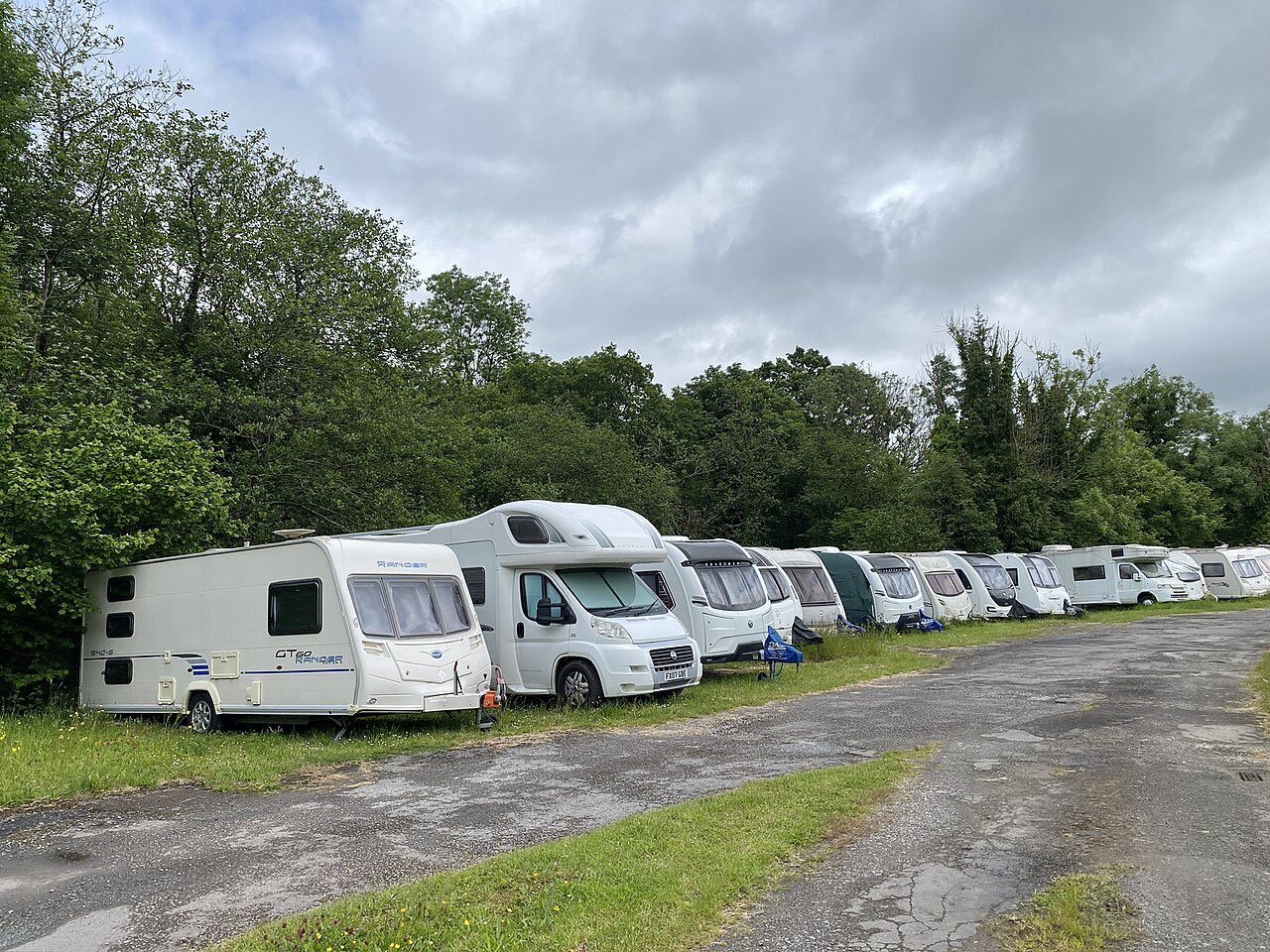
Expect to show current registration, proof of insurance, and a rig that runs or rolls; most lots refuse derelicts because they end up owning them. Read the contract for the access hours (a gate that closes at 7 p.m. matters on a Friday departure), whether electricity is available for a battery maintainer and at what price, whether a dump station and water are on site, how they handle snow, and the notice period to leave. Ask to see the actual space: a spot under a tree is a spot under sap and branches, and the back corner of a lot is where the fence is cut.
Covered and indoor facilities add height and length limits. Measure your rig with the air conditioner and antenna, not from the brochure.
Parking at home: the 72-hour problem
The cheapest storage is your own driveway, which is why cities regulate it. Two real ordinances show the shape of the rules.
The City of Sharonville, Ohio, allows an RV in front of a house on a hard-surface driveway for no more than 72 hours; an RV stored (parked more than 72 hours) must sit on asphalt or concrete in the side or rear yard, and may not exceed 24 feet long or 14 feet high; anything larger needs a Conditional Use Permit (Sharonville residential vehicle rules). The City of Sebastopol, California, bars RVs from residential-zoned streets for more than 72 hours, allows residents and guests those 72 hours for loading and unloading, prohibits parking within 30 feet of a corner at any time, and bars cords, hoses and sewer connections across the sidewalk; enforcement is complaint-driven and ends in a citation or a tow (Sebastopol RV parking ordinance). Other cities in our search used the same 72-hour figure with permit counts per year, front-yard bans, and surface requirements.
Three practical conclusions. A 24-foot limit excludes most fifth wheels and Class As outright. “Side or rear yard on a hard surface” usually means a gate wider than the rig and a concrete pad you pay to pour. And the enforcement trigger is almost always a neighbour, so a rig that is invisible from the street is a rig that is rarely cited, which is also the HOA’s logic: covenants commonly ban any RV visible from the street, with no 72-hour grace. Check the municipal code (search the city’s name plus “recreational vehicle” and “municipal code”) and the HOA covenants before the purchase; the first-year ownership costs guide puts storage in the budget where it belongs.
Insurance while the RV sits
Two questions: what to keep, and what you can drop.
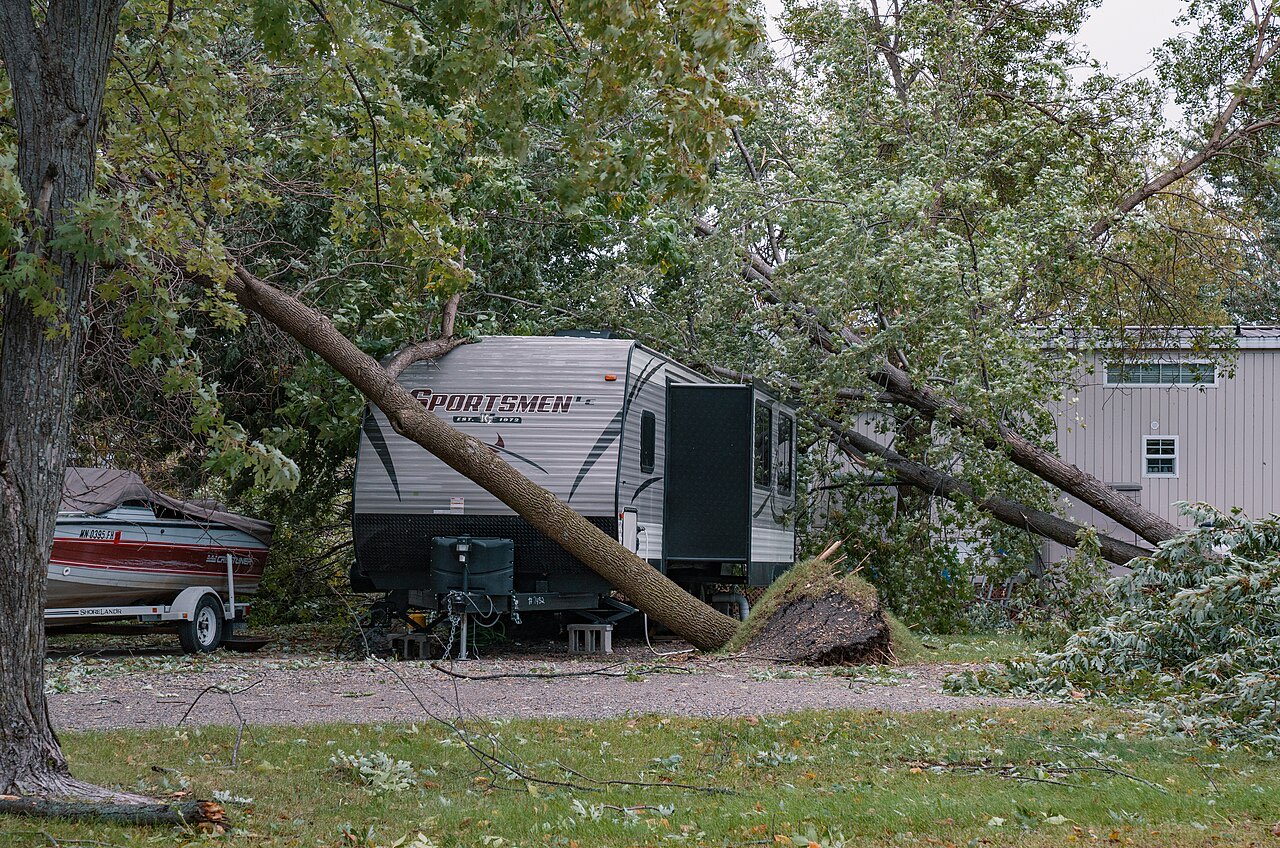
Keep comprehensive. It is the coverage for the things that happen to a parked RV: theft, vandalism, fire, hail, flood, a tree through the roof. Storage facilities generally require proof of it, and Progressive’s RV page notes that a travel-trailer policy typically cannot be bought without it.
Ask about a storage option. National General’s RV insurance page describes a Storage Savings Option that suspends collision and liability while the RV is not in use, for savings up to 53 percent of the premium, subject to state availability (National General RV insurance); Good Sam’s FAQ applies the option to storage of 30 days or more. Not every insurer offers it, and reports on whether Progressive will reduce coverage for storage conflict, so ask yours directly. Two limits: a motorhome is a registered motor vehicle, and Progressive’s page says liability is required in nearly every state, so some states will not let you drop it while the plates are on; and a trailer that will be towed to and from the lot needs its coverage back on before it moves. Note the date the option starts and ends.
Prep before it sits
What goes wrong in storage is water, rodents, batteries and tires, in that order of cost.
- Tanks and plumbing. Dump and rinse black and grey, drain fresh, and if there is any chance of freezing, winterize fully; the how to winterize an RV guide covers the antifreeze-versus-blowout choice. A tank left with contents for a winter is a tank you replace.
- Roof and seals. Inspect and reseal before storage, not after. Covered storage does not excuse this; wind-driven rain gets under canopies.
- Slides in. Lippert’s slide-out manual recommends the room be retracted for long-term storage; the seals and toppers are not designed to sit extended for months.
- Food, fabric and holes. Everything edible out, including the spice rack; mattresses lifted or covered; steel wool or mesh in every hole where a wire or hose enters the floor. Rodent damage to wiring is the most expensive common storage claim and is often excluded.
- Batteries. Either disconnect them and keep them charged with a maintainer, or remove them to somewhere cool. Lithium batteries have their own storage charge level and temperature rules from the maker; a lead-acid battery left connected to a parasitic draw will be dead and sulfated by spring. Follow the battery maker’s instructions over any generic advice.
- Tires. Michelin’s RV tire guide is specific: clean the tires with soap and water, put a barrier (plastic, plywood, cardboard or a rubber mat) between tire and ground, cover them against sunlight and UV if outdoors, inflate to the maximum pressure on the sidewall, and if storage exceeds three months consider a monthly hour-long highway drive so the tire warms and its protective waxes migrate to the surface (Michelin RV tire guide, long-term storage section). Goodyear’s guide adds a pressure check at least monthly while stored. Our RV tire age and pressure guide explains why a stored tire ages faster than a used one.
- Propane off at the cylinders; vents closed but with a desiccant bucket inside in humid climates; a cover only if it is breathable and fitted, since a tarp that flaps for six months sands the finish.
Gear for an RV in storage
As an Amazon Associate we earn from qualifying purchases.
- Master Lock 379ATPY trailer coupler lock: A coupler lock for a towable in a storage lot.
 $35.99Price as of November 16, 2026, 10:00 AM ET. Prices and availability are accurate as of the date/time indicated and are subject to change. Any price and availability information displayed on Amazon.com at the time of purchase will apply to the purchase of this product.
- MaxxHaul solid rubber wheel chocks, 2 pack: Chocks on the tires of a parked trailer.
 $15.99Price as of November 16, 2026, 10:00 AM ET. Prices and availability are accurate as of the date/time indicated and are subject to change. Any price and availability information displayed on Amazon.com at the time of purchase will apply to the purchase of this product.
Is storage worth it at all?
Add the storage bill to the loan, insurance and depreciation and the arithmetic sometimes says no. An RV used four weekends a year at $150 a month of storage pays $1,800 a year to sit, before anything else; the rent vs buy guide runs that comparison properly. If the answer is still yes, the cheapest safe choice is usually covered storage a little further from home than is convenient, with comprehensive insurance, the slides in, the tires off the dirt, and a monthly visit that checks for water and mice. Prices, ordinances and insurance terms above are as published on 28 October 2026 and vary by city, state and insurer; confirm all three for your own rig before signing anything.
Frequently asked questions
How much does RV storage cost per month?
In Extra Space Storage's 2026 price guide, outdoor uncovered space typically runs $99 to $119 a month, covered $121 to $216, and indoor $180 to $309, with climate control $25 to $50 more; the full range across its markets is $35 to $582. SpareFoot's city averages in 2026 ran from about $186 in Altamonte Springs, Florida, to $448 in Springfield, Virginia. Length, metro area and the season all move the number, so get three local quotes.
Is covered RV storage worth the extra cost?
Usually, if you are storing for more than a season. The roof is where RVs fail: sun degrades rubber and sealant, standing water finds any gap, and snow load stresses seams. Covered space in Extra Space's guide costs about $20 to $100 a month more than uncovered. One avoided roof reseal or water-damage repair pays for years of the difference. Indoor storage adds protection from hail and theft but can cost double.
Can I just park my RV in my driveway?
Often not for long. Many cities limit RV parking at a residence to 72 hours unless it is in a side or rear yard on a hard surface, and some cap length and height; Sharonville, Ohio, for example, allows 72 hours in front, requires stored RVs to be in the side or rear yard on asphalt or concrete, and caps them at 24 feet long and 14 feet high. Sebastopol, California, bars RVs from residential streets beyond 72 hours and within 30 feet of a corner. Homeowners' associations are frequently stricter. Read the municipal code and the HOA covenants before buying the RV, not after.
Do I need to keep insurance on an RV in storage?
Keep comprehensive at minimum; it covers theft, fire, hail, vandalism and falling trees, which are exactly the risks in a storage lot, and most storage facilities require proof of insurance. Some insurers offer a storage option that suspends collision and liability while the RV is not in use: National General advertises savings up to 53 percent of the premium, and Good Sam's FAQ applies it to storage of 30 days or more. Motorhomes still need liability in nearly every state while registered, so ask your insurer what it allows in your state.
What should I do to an RV before storing it?
Empty and rinse all three tanks, winterize the plumbing if it will freeze, retract the slides (Lippert's manual recommends rooms closed for long-term storage), remove food and anything that attracts rodents, disconnect or maintain the batteries per the battery maker, clean and cover the tires, inflate them to the sidewall maximum, and close the propane. Michelin's RV tire guide adds a barrier between tire and ground and a monthly one-hour drive if storage runs past three months.
Keep planning
- First-Year RV Ownership Costs You Don't See at the Dealer
First-year RV ownership costs beyond the sticker: sales tax, registration, insurance, storage, hitch gear, tires, warranties and depreciation, with official figures.
Updated Oct 2026 - Full-Time RV Living Cost: Monthly Budget by Travel Style
Full-time RV living cost in three monthly budgets, frugal to comfortable, built from official 2026 prices: park and BLM fees, EIA fuel, insurance, Starlink.
Updated Oct 2026 - Black Friday RV Campground Membership and Gear Deals 2026
What to look for in RV campground memberships and outdoor gear Black Friday deals in 2026, including Thousand Trails, KOA and Harvest Hosts.
Updated Nov 2026