Leveling Blocks vs Auto-Leveling Jacks on an RV
In this guide
- Why level at all, in one paragraph
- The three ways to level, compared
- Leveling blocks: what the makers allow
- Auto-leveling jacks: what the manuals say
- A typical setup, start to finish, with each method
- Stabilizer jacks are not leveling jacks
- Who should buy what
- Mistakes to avoid
- Gear that helps with this job
For most travel trailers and smaller rigs, leveling blocks (or curved levelers) under the tires and the tongue jack for front-to-back do the job in minutes at a small fraction of the cost of an auto-leveling system. Auto-leveling jacks make sense on heavy fifth wheels and motorhomes, for people who move often, and for anyone who cannot kneel at a tire and crank. Even then you keep a set of blocks, because jacks need pads on soft ground. The one rule that holds for every rig: stabilizer jacks are not leveling jacks.
This page is the decision: what each method does, the limits the manufacturers set, and who should buy what. For the leveling procedure itself, step by step, see our how to level an RV guide. Sources are the Lippert Ground Control 3.0 owner’s manual, a Jayco owner’s manual and the block and leveler makers’ own listings, read in October 2026.
Why level at all, in one paragraph
Three things need a level RV: an absorption refrigerator (Norcold’s manual allows 3 degrees side to side and 6 degrees front to back), slide-outs (Lippert’s slide manual starts with “Level unit”), and the people inside, who notice a tilt long before the fridge does. Tanks also drain better from a level rig. Our refrigerator guide covers the fridge in detail.
The three ways to level, compared
| Interlocking blocks | Curved levelers | Auto-leveling jacks | |
|---|---|---|---|
| What it is | Stackable plastic squares under tires and jack feet | A curved ramp you drive onto, locked with a wedge chock | Powered hydraulic or electric jacks that lift and level on command |
| Adjustment | In steps, about 1 in. per layer on common blocks | Any height within the ramp’s range (Andersen: 1/2 to 4 in.) | Continuous; the controller finds level |
| Handles side to side | Yes | Yes | Yes |
| Handles front to back | Trailers: use the tongue jack or landing gear; motorhomes: blocks under one axle | Trailers: tongue jack | Yes |
| Typical cost | Low; a 10-pack is a modest purchase | Andersen’s own page listed $54.99 each in October 2026 | Typically thousands of dollars installed or as a factory option; get a dealer quote |
| Weight and space | A bag in a bay | Two ramps and chocks in a bay | Permanent; adds weight under the RV |
| Failure mode | Stack shifts if built badly | Tire larger than the ramp is rated for | Hydraulic leak, electrical fault, dead battery |
| Best for | Travel trailers, small motorhomes, vans, every rig as backup | Single- and tandem-axle trailers that level side to side often | Heavy fifth wheels, Class A and C motorhomes, frequent movers |
Leveling blocks: what the makers allow
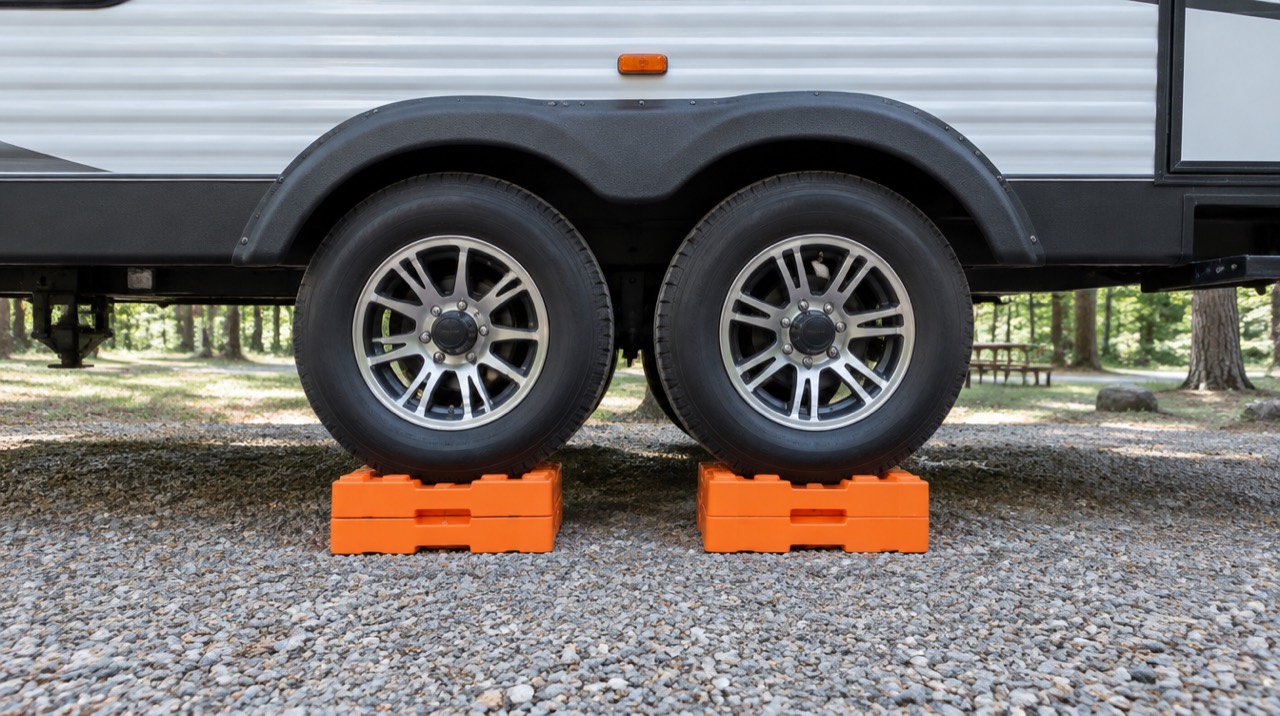
The common interlocking type is the Tri-Lynx Lynx Leveler. Its maker lists each block at about 8.5 by 8.5 inches and 1.5 inches thick, about 1 inch of lift per layer when interlocked, and says the blocks withstand weights up to 40,000 pounds. That rating is the maker’s; its listing does not spell out whether it applies per block or per stack, so treat it as a material rating, not permission to build tall towers. Tri-Lynx’s maker copy, as carried on retail listings, recommends no more than about 5 inches of stacking height.
How to use them well:
- Pyramid, not tower. Wider base, narrower top, and longer than the tire’s footprint so the tire sits fully on the top layer.
- Both tires on a tandem axle. Equal stacks under both tires on the low side, or one ramp of blocks both tires can roll onto. A single tire up and its partner on the ground overloads one tire and one axle.
- Under the tongue jack and stabilizer feet as pads, especially on soft ground. Jayco’s manual suggests a wood pad or equivalent under stabilizer feet to stop them sinking.
- Chock after you are on the blocks. Our wheel chocks guide covers placement.
Curved levelers (the Andersen type) are a variation: you drive onto a curved ramp until the bubble reads level, then push a wedge chock in behind the tire to lock it. Andersen rates its Camper Leveler for trailers up to 30,000 pounds and tires up to 32 inches, adjustable at any increment from 1/2 to 4 inches, according to its own listing. There is no stacking and no getting out to add a layer, which is why trailer owners who level side to side at every stop like them.
Auto-leveling jacks: what the manuals say
An auto-leveling system is a set of powered jacks with a controller. On Lippert’s Ground Control 3.0 for fifth wheels, the manual describes the sequence: the front seeks level, the rear jacks ground, then side to side. Its preparation steps are the part owners skip:
- Park on solid, level-as-possible ground and clear debris from where each jack lands.
- Have the battery fully charged or be plugged into shore power; the jacks draw heavily.
- On fifth wheels, extend the front landing gear’s inner legs to within 4 to 5 inches of the ground first.
- No movement inside the trailer while the system levels.
- On six-point systems, the two middle jacks stabilize only; they do not level.
- The trailer must be supported with jack stands for any service, never solely by the jacks.
That last line is the important limit. Leveling jacks hold a coach level for living in. They are not a lift for changing a tire or crawling underneath.

A typical setup, start to finish, with each method
With blocks on a travel trailer: check the side-to-side bubble while still hitched, lay a stack in front of both low-side tires, pull forward onto them with a spotter, chock, then unhitch and set front to back with the tongue jack. Lower the stabilizers last. With practice it takes a few minutes; the first few times take longer because you are guessing how many layers you need.
With curved levelers: set a ramp in front of each low-side tire, drive on slowly until the bubble centers, stop, set the brake and push the wedge chocks in. Unhitch and finish with the tongue jack. There is no guessing at layers.
With auto-leveling: park, check the jack landing spots for rocks and soft ground, lay pads, make sure you are on shore power or a charged battery, press the button and wait outside. Then chock. The time saved is real, but the preparation is not optional.
Stabilizer jacks are not leveling jacks
Most travel trailers come with four corner stabilizer jacks, manual crank or electric. They look like leveling jacks and they are not. Jayco’s manual says it in capitals: do not use the stabilizer jacks to level the RV. They are for support while you move around inside, are not designed to carry the RV’s weight, and must never support the RV while someone is under it or a tire is off. Level first, then lower the stabilizers until they touch and take the bounce out. Retract them fully before towing, or they bend.
Who should buy what
- Weekend travel trailer, under about 30 feet: a 10-pack of interlocking blocks, a bubble level or two, and chocks. Add curved levelers if you hate stacking.
- Fifth wheel without auto-level: blocks under the tires, the landing gear for front to back, pads under the landing-gear feet. A 6-point auto-level system is a real upgrade on a heavy fifth wheel, but price it against how often you move.
- Motorhome with factory hydraulic jacks: pads for every jack foot and a set of blocks for sites too steep for the jacks’ travel.
- Motorhome without jacks: blocks under one axle or one side, driven onto slowly with a spotter.
- Full-timers who move every few days, or anyone who cannot kneel and crank: auto-leveling earns its cost in time and joints. Keep blocks anyway.
Before paying for any system, weigh the rig. A leveling system adds weight under the RV that comes out of your cargo capacity; our CAT scale guide shows how to find the real numbers. We did not find a published added-weight figure we could verify, so ask the installer.
Mistakes to avoid
- Leveling with stabilizer jacks. Jayco says no; the jacks bend and the frame twists.
- Stacking blocks past the maker’s limit or building a tower narrower than the tire.
- One tandem tire on blocks, the other on the ground.
- Running auto-level on a weak battery or with people moving inside.
- Jack feet straight onto hot asphalt or soft ground with no pad.
- Working under an RV held up by leveling jacks. Use rated jack stands.
- Unhitching before chocking. Lippert’s manual says chock the tires before unhitching.
Gear that helps with this job
Two ways to level the tires, depending on whether you prefer stacking or driving on. Either one stays useful after an auto-level upgrade.
As an Amazon Associate we earn from qualifying purchases.
- For most people: Tri-Lynx Lynx Levelers interlocking blocks, the 11-pack with 10 blocks, a Lynx Cap top piece and a storage bag. They level tires, pad the tongue jack and stabilizer feet, and work as jack pads under hydraulic jacks. Respect the maker’s stacking limit.
 $33.18Price as of November 16, 2026, 10:00 AM ET. Prices and availability are accurate as of the date/time indicated and are subject to change. Any price and availability information displayed on Amazon.com at the time of purchase will apply to the purchase of this product.
- For trailer owners who level side to side at every stop: the Andersen Camper Leveler 2-pack. Drive on until level, push the chock in, done; Andersen rates it for trailers to 30,000 pounds and tires to 32 inches, adjustable from 1/2 to 4 inches. Two levelers let you raise both tires of a tandem axle in the same pass.
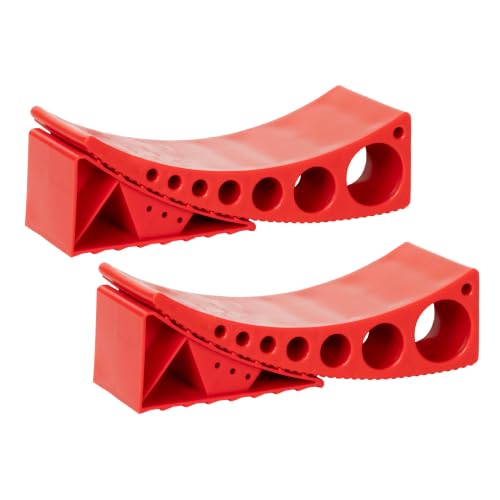 $95.98Price as of November 16, 2026, 10:00 AM ET. Prices and availability are accurate as of the date/time indicated and are subject to change. Any price and availability information displayed on Amazon.com at the time of purchase will apply to the purchase of this product.
- To read pitch and roll while you drive onto the blocks: a phone display is a separate tool from blocks and from leveling jacks. The RV gear and upgrades guide covers the HUNKING Bluetooth unit’s listing, including the measurements that listing leaves out.
Listings and prices change; check the current listing before you buy.
Limits and procedures above are from Lippert’s and Jayco’s manuals and the makers’ listings as read in October 2026. Your RV’s and your leveling system’s manuals govern. If you are choosing a rig and want to know which sites it will fit, our sister site covers national parks with pull-through sites.
Frequently asked questions
Are auto-leveling jacks worth it on a travel trailer?
For most travel trailers, no. Interlocking blocks or curved levelers under the tires, plus the tongue jack for front-to-back, level a trailer in a few minutes for a small fraction of the cost. Auto-leveling earns its place on heavy fifth wheels and motorhomes, where cranking and repositioning take real effort, and for owners who move every day or two or have physical limits.
Can I use stabilizer jacks to level my RV?
No. Jayco's owner's manual says in capitals not to use stabilizer jacks to level the RV; they are for support while you move around inside and are not designed to carry the RV's weight. Level first with blocks, levelers, the tongue jack or a true leveling system, then lower the stabilizers to take out the rock.
How high can you stack RV leveling blocks?
Follow the block maker's limit. Tri-Lynx's maker copy, as carried on retail listings, recommends no more than about 5 inches of stacking height for Lynx Levelers, which lift about 1 inch per layer when interlocked. Build stacks as a pyramid, wider at the bottom, and make the stack longer than the tire's footprint so the tire sits fully on it.
Do I still need leveling blocks if I have auto-leveling jacks?
Usually yes, as pads. Hydraulic and electric jacks need a firm surface, and on gravel, grass or hot asphalt a block or pad under each jack foot spreads the load and keeps it from sinking. On a steep site, blocks under the jack feet also reduce how far each jack has to extend.
Can I lift the wheels off the ground with leveling jacks?
Check your system's manual; many makers warn against it, and none we read treat jacks as a support for working under the RV. Lippert's Ground Control 3.0 manual says the trailer must be supported with jack stands for any service and never solely by the leveling jacks. Wheels off the ground also means the parking brake and chocks no longer hold anything.
Keep planning
- How to Use an RV Dump Station Step by Step
How to use an RV dump station: black-then-gray order, hose setup, rinsing, chemicals, where to find free stations, typical fees and what never goes down the drain.
Updated Nov 2026 - RV Sewer Hose Setup: Length, Supports and Fittings
RV sewer hose setup explained: what length to carry, the clear elbow and 4-in-1 adapter, hose supports for a steady downhill run, valve habits and clean storage.
Updated Nov 2026 - RV Gear and Upgrades: Measure Before You Order
Fit guide for RV steps, bunk ladders, windows, shades, hose tubes, tote carriers and vents. Sizes come from the Amazon listings, including where a listing disagrees.
Updated Nov 2026